Food shopping can make a careful budget feel broken. The Financial Influencer Network, or FIN, is a network of 33 financial educators, creators, and advisors. In this article, we combine FIN’s consumer finance perspective with guidance from Tiffany Aliche, known as The Budgetnista and author of Get Good With Money, to address a practical problem: how to keep grocery spending from crowding out bills and savings when food prices have been climbing.
Distinctive Value: Give Grocery Money Its Own Account
Most grocery budgets fail for a reason that has little to do with discipline. Grocery money and bill money often sit in the same checking account, so every purchase becomes a real-time judgment call.
A grocery run competes with rent, utilities, debt payments, transportation, and other obligations. When the account balance looks healthy early in the pay period, it is easy to spend more at the store. Later, the same balance has to cover bills that cannot be delayed.
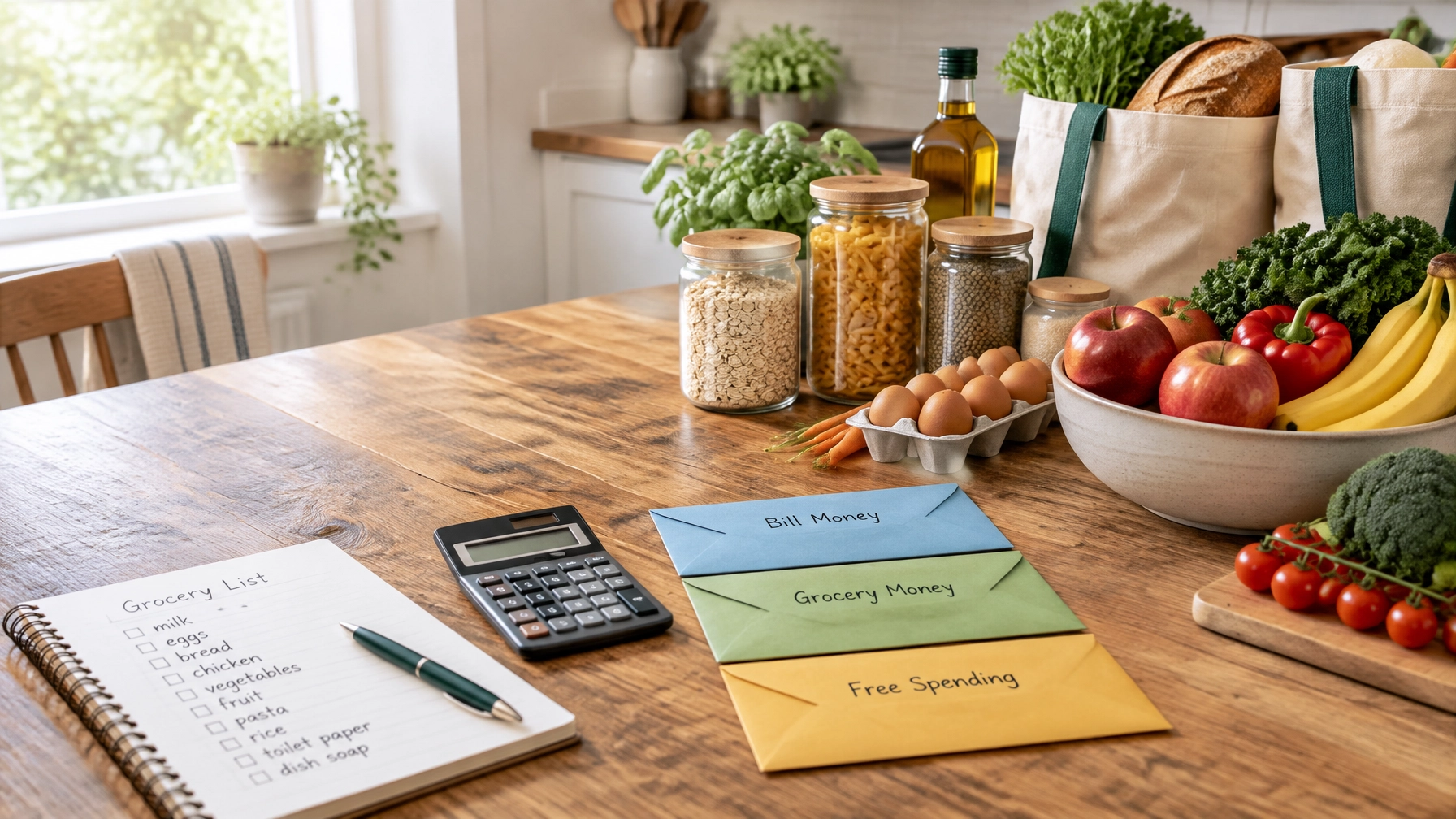
The solution is a simple three-account structure:
- Bill money: Rent, utilities, debt payments, insurance, subscriptions, and other required expenses.
- Grocery money: A fixed amount transferred weekly or every pay period.
- Free spending: Money for dining out, entertainment, gifts, hobbies, and other flexible purchases.
This third-account method changes grocery shopping from an open-ended decision into a defined spending limit. You are not asking, “Can I afford this item today?” You are asking, “Does this fit within the grocery money available for this shopping trip?”
Quick Answer
To stretch your grocery budget, separate grocery money from bill money, set a realistic weekly amount, and check your list against your actual pantry and the store’s prices before shopping. Tiffany Aliche recommends using a delivery app to build a list even when you shop in person, staying loyal to one store for points and coupons, watching for local market deals, and avoiding unnecessary delivery fees.
The goal is not to create a perfect meal plan or never buy something enjoyable. The goal is to build a grocery system that protects essential bills and reduces impulse spending when every item feels more expensive.
Why Grocery Prices Feel So Heavy
Food is a recurring expense that most households cannot eliminate. You may reduce restaurant meals or delay buying clothing, but people still need to shop for groceries every week.
The pressure also shows up in many small decisions. A slightly higher price on several staples, a larger household, or an unplanned top-up trip can make the monthly budget feel stretched. Because groceries are purchased frequently, the impact is visible long before some other annual expenses come due.
That is why a grocery budget needs more than a target written in a notebook. It needs a boundary that is visible when you shop.
Build the Three-Account System
Start with the money that has the least flexibility. Add up your regular bills and other necessary expenses. Then decide how much can reasonably go toward groceries. The amount left can support free spending, but it should not be treated as available grocery money.
For example, suppose your household decides that $560 per month is a realistic grocery amount. You could transfer $130 into a grocery account each week and leave the remaining $40 in that account as a cushion or rollover amount. The exact numbers will vary, but the structure matters.
A few rules make the system easier to maintain:
- Transfer grocery money on a consistent schedule.
- Use the grocery account or debit card for food shopping.
- Do not use bill money to quietly cover an oversized cart.
- If the grocery account runs low, pause and review the list before transferring more.
- If the amount is regularly inadequate, revise the budget honestly rather than relying on willpower.
A separate account will not make food cheaper by itself. It creates clarity. That clarity can prevent a grocery decision from becoming a bill-paying problem later in the month.
Use Technology Before You Enter the Store
One of Aliche’s practical suggestions is to use a delivery app to build your grocery list, even if you plan to shop in person. The value is not necessarily placing a delivery order. It is being able to check what you already have at home and see prices before you begin browsing store aisles.
This approach can help you:
- Review your pantry and refrigerator first.
- Add items to a planned list instead of shopping from memory.
- See the likely cost before leaving home.
- Remove items when the total exceeds your grocery balance.
- Reduce impulse purchases caused by walking past displays.
The app becomes a planning tool rather than a shortcut to convenience spending. If delivery is necessary, Aliche advises skipping expensive third-party delivery services when possible and checking whether the store offers its own delivery service, which is typically cheaper.
The key is to compare the final cost with the grocery money available. A delivery fee, service fee, or tip may be worthwhile when time is scarce, but it belongs in the shopping decision.
Stay Focused Instead of Chasing Every Deal
Aliche also recommends staying loyal to one store so you can build up points and coupons rather than scattering small purchases across several stores. She suggests following stores on social media to learn about deals and promotions.
This does not mean one store will always have the lowest price on every item. It means the value of loyalty rewards and a simpler routine may outweigh the time, transportation, and temptation involved in visiting multiple locations.
A useful question is: “Will this deal save enough to justify the extra trip or extra items I might buy?” If the answer is no, staying with your regular store may be the better financial decision.
Consider Local Markets and Bulk Options
Aliche recommends checking local markets for fresher, cheaper bulk items. Depending on your area, a neighborhood market may offer better value on produce, herbs, grains, or other foods you purchase regularly.
The important word is regularly. Bulk buying only saves money when the household uses the food before it spoils and has a practical way to store it. A low price per unit is not a bargain if part of the purchase is wasted.
Try comparing the total cost, the amount your household can use, and the storage required. The grocery account gives you a useful test: if a bulk purchase consumes most of the week’s money, it may not be the right choice even if the unit price looks attractive.
What This Means for You
A grocery budget becomes more useful when it works during an ordinary stressful week, not only when everything goes according to plan.
Use this setup:
- Open or designate a separate grocery account. It can be a basic checking account or another account that makes spending easy to track.
- Calculate a realistic grocery amount. Review recent spending instead of choosing a number that looks impressive but cannot support your household.
- Divide the amount by your pay schedule. Weekly transfers can make the limit easier to see than one large monthly deposit.
- Check your home before making a list. Look at the pantry, refrigerator, and freezer so you do not pay twice for items you already own.
- Price the list in an app. Remove or replace items before shopping if the total exceeds the grocery account balance.
- Use store loyalty tools. Points, coupons, and social media promotions may reduce the cost of a regular shopping trip.
- Compare delivery choices. If you need delivery, check the store’s own service before using a more expensive third-party option.
- Review the system after a difficult week. A higher grocery bill may reflect a real need, a planning gap, or a budget that needs to be adjusted.
If the numbers show that bills, groceries, and necessary expenses consistently exceed take-home pay, the issue is larger than shopping technique. A broader review of cash flow may help, including the budgeting and financial planning resources available through Ask The Money Coach.
The final takeaway is simple: the goal is a grocery system that survives a bad week, not a perfect month.
Frequently Asked Questions
How does a separate grocery account help control spending?
A separate grocery account creates a clear boundary between food money and money reserved for bills. It turns grocery shopping into a fixed cash-flow decision instead of an ongoing guess based on the balance in one general account.
Should I use a separate checking account for groceries?
A separate checking account can work well because it allows you to use a dedicated debit card and monitor the balance easily. The most important feature is separation, not the specific type of account, so choose an option that does not add unnecessary fees.
Can I use a delivery app if I plan to shop in person?
Yes. Tiffany Aliche recommends using a delivery app to build and price a list even when you shop in person. This can help you review what you already have at home and limit impulse browsing.
Is it better to shop at only one store?
Staying loyal to one store may help you build points and coupons, while also reducing the time and extra purchases associated with visiting several stores. However, compare the total value of loyalty savings with local market prices and the cost of making additional trips.
What should I do if my grocery money runs out before the week ends?
First, review whether the issue came from an unusual need, impulse purchases, or an amount that is consistently too low. Avoid taking money from the bill account automatically, and use the review to adjust the grocery transfer or shopping routine based on real household needs.
AskTheMoneyCoach Staff is the collective byline for our editorial team. Founded by Lynnette Khalfani-Cox, The Money Coach®, and Earl Cox, AskTheMoneyCoach.com publishes practical, research-informed guidance on credit, debt, saving, consumer protection, and everyday money decisions. Our work follows the site’s editorial standards and helps readers understand their options and make informed choices.