Over the last few years, proprietary trading firms – better known as prop firms – have transformed from niche institutions into one of the most influential forces in modern trading. They’ve opened doors for talented individuals across the world, allowing them to trade substantial capital without risking their personal savings.
But even as prop trading gains momentum, one question keeps coming up: how do these firms actually make money if they’re giving traders funds to trade with?
The answer reveals a fascinating, balanced business model that thrives on skill, discipline, and shared success.
What Exactly Is a Prop Firm?
A prop firm is a company that gives qualified traders access to its own capital. The traders use that capital to buy and sell in markets like forex, futures, or commodities. When they make profits, those profits are shared between the trader and the firm.
This model differs from that of brokers or investment managers. A broker earns from spreads, commissions, and trading volume, while an investment manager profits by charging management or performance fees on client funds. A prop firm, on the other hand, doesn’t rely on clients at all. It takes its own money, entrusts it to capable traders, and grows that capital through shared performance.
In essence, it’s a partnership. The trader brings skill, strategy, and time; the firm provides the capital, structure, and technology. The better the trader performs, the more both sides earn.
How the Prop Firm Model Works
The process usually begins with an evaluation phase. Traders are asked to prove their ability to trade profitably while adhering to risk management rules. This stage often takes place in a simulated environment and involves clear targets – reaching a certain profit percentage without exceeding a maximum drawdown.
If the trader meets the criteria, they advance to a funded account, where they trade with the firm’s money under similar risk parameters. From there, profits are split, often in the trader’s favor. Over time, successful traders can scale their funding levels and take on larger accounts, earning proportionally higher payouts.
For traders, the benefits are obvious. They get to trade large capital without endangering personal savings. For firms, the payoff comes from identifying and partnering with traders who can deliver consistent returns. The model creates a sustainable ecosystem in which both sides share rewards and responsibilities.
How Prop Firms Make Money
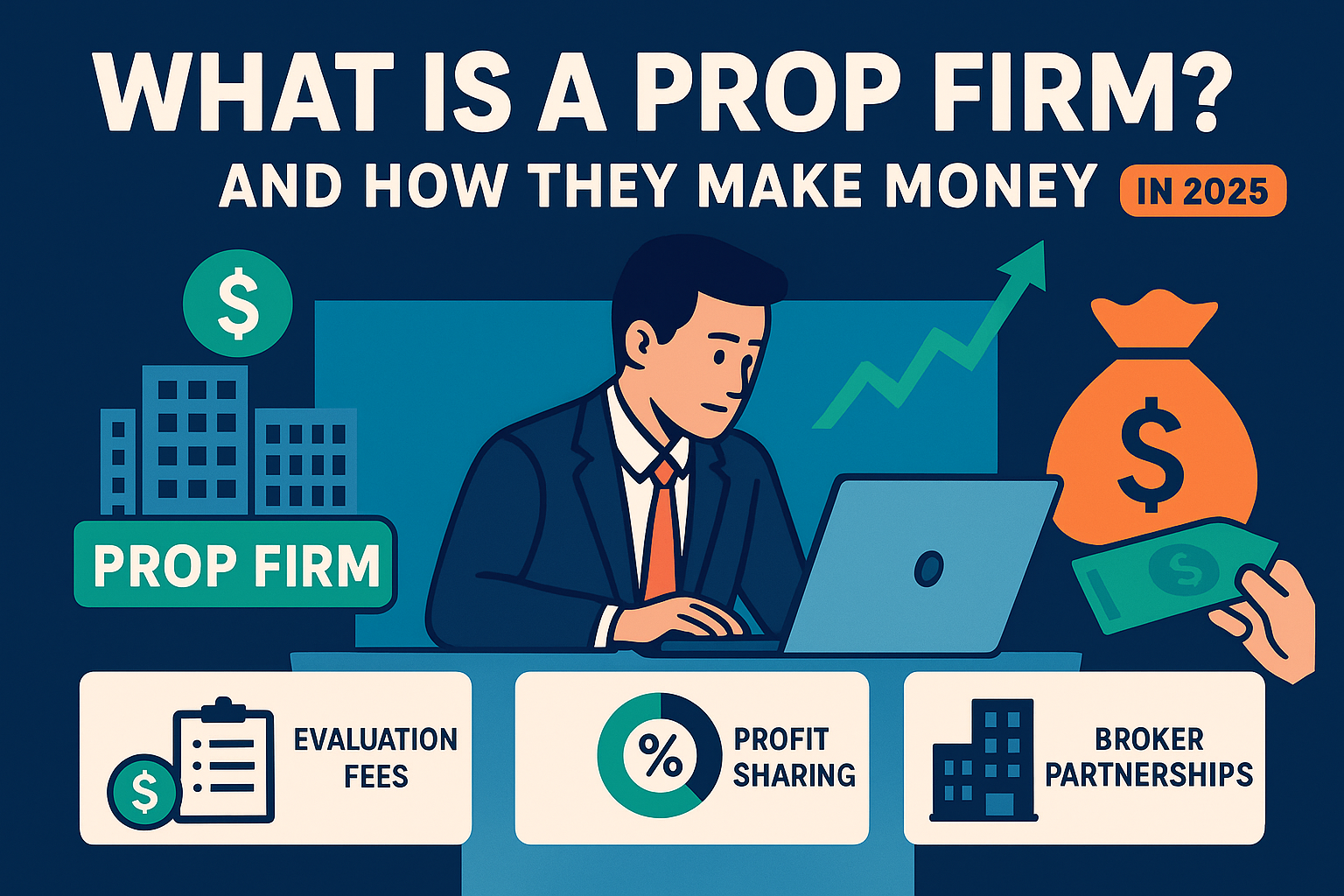
Many traders assume prop firms earn only from the evaluation fees they charge. While those fees do play a role, they’re just one part of a broader revenue system that keeps the firm healthy.
Here’s where most of a prop firm’s income comes from:
- Evaluation or Challenge Fees: Traders pay a one-time fee to take an evaluation. These fees help the firm cover infrastructure, data access, and operational costs. They also act as a filter, ensuring only committed participants take part. Reputable firms reinvest much of this income into improving technology, paying out funded traders, and expanding resources.
- Profit Sharing: Once traders are funded and start generating returns, the firm earns a percentage of those profits. This is the most important long-term income stream because it scales with performance. When the trader wins, the firm wins too.
Some larger firms also form partnerships with brokers or liquidity providers, allowing them to benefit from volume-based discounts or rebates. Others use data and risk management tools to hedge exposure or balance positions when too many traders take similar trades. These mechanisms aren’t about speculation – they’re about protecting the firm’s capital while maintaining a fair, transparent structure for traders.
The Misconceptions About Prop Firms
Because the prop trading industry has expanded so rapidly, it’s attracted both reputable companies and less trustworthy operators. This has created a few common misconceptions.
The first is the belief that prop firms make money only when traders fail. While some low-quality firms might rely heavily on evaluation fees, successful and sustainable ones depend on funded traders who stay profitable for months or years. Long-term consistency generates far more revenue than constant turnover.
The second misconception is that funded accounts are “fake.” Most prop firms use simulated environments for evaluations to minimize risk, but when a trader qualifies, payouts are real. Many firms mirror funded traders’ positions in live markets or base payouts directly on verified trading results. The system allows firms to manage exposure efficiently while still rewarding genuine performance.
A third misconception is that rules are unnecessarily strict. In truth, these rules – like drawdown limits or trading windows – exist to enforce risk discipline. They protect both trader and firm from emotional or reckless decision-making. Ironically, many traders find that their performance improves after joining a prop firm precisely because of these constraints.
Why Prop Firms Are So Popular in 2025
The rise of prop trading coincides with broader shifts in how people approach financial independence. Remote work, advanced technology, and low trading barriers have created an ideal environment for traders to turn their skills into sustainable income.
Prop firms make that transition realistic. They remove the financial barrier that prevents many talented traders from scaling up. Instead of saving for years to grow a personal account, traders can start trading significant sums immediately, provided they prove their skill.
Another factor is the professional environment that prop firms create. They give traders access to premium platforms, performance analytics, and ongoing mentorship or community discussions. The sense of belonging to a structured ecosystem – rather than trading alone – helps many traders achieve consistency.
And then there’s the global nature of modern prop trading. A skilled trader in South Africa, Malaysia, or Poland can now trade for a U.S.- or Europe-based firm and receive payouts within days. Capital, knowledge, and opportunity have become borderless, and that inclusivity has fueled enormous growth across the industry.
How Traders and Firms Stay Aligned
The partnership between trader and firm works because both benefit from the same outcome: profitable, sustainable trading. Prop firms want traders to succeed because it increases their own returns and strengthens their brand reputation.
That alignment is reinforced through careful risk management and transparent payouts. Most firms provide dashboards where traders can track their progress, performance metrics, and upcoming payouts in real time. The professional transparency that once only existed on institutional desks is now available to independent traders from their laptops.
This system rewards discipline. Traders who approach prop trading as a business – tracking results, refining strategies, and respecting rules – often find themselves scaling faster and earning more than they ever could trading their own small accounts.
The Future of Prop Trading
As we move further into 2025, the prop trading industry continues to mature. Artificial intelligence and data analytics are now being used to monitor risk, assess trading behavior, and identify promising candidates faster.
Firms are also beginning to offer multi-asset funding programs that include forex, indices, crypto, and commodities under one umbrella. Regulation is tightening too, which means transparency and accountability are likely to keep improving.
In short, prop trading has evolved from an experimental opportunity into a legitimate career path. The best firms are setting new standards for professionalism in independent trading, and that trend shows no sign of slowing down.
Final Thoughts
A prop firm isn’t just a company handing out money – it’s a partner that shares both risk and reward with its traders. It earns through evaluation fees and profit sharing, but its long-term health depends on cultivating successful, disciplined traders who can generate consistent returns.
For traders, this model represents something revolutionary. It breaks the traditional barrier between talent and opportunity, allowing skill – not starting capital – to define success.
Understanding how prop firms make money gives traders a clearer sense of what to look for and what to avoid. Reputable firms don’t need to exploit failure; they thrive on success. When that alignment exists, prop trading becomes one of the most empowering paths in modern finance – where anyone with discipline, patience, and skill can trade big, grow steadily, and earn their place in the professional ranks.
FAQs
What is a prop firm and how does it work?
A prop firm provides traders with its own capital to trade in markets. Profits are shared between the trader and the firm, creating a partnership based on performance.
How do prop firms make money?
They earn through evaluation fees, profit sharing, and partnerships with brokers or liquidity providers. The best firms rely on long-term, successful traders for sustainable profits.
Are prop firm funded accounts real?
Yes. While evaluations often take place in simulated environments, payouts are real. Many firms mirror trades in live markets to manage exposure.
Why are prop firms becoming so popular?
Prop firms have made trading accessible worldwide, offering capital, technology, and structure to traders who prove their skills without risking personal savings.
What should traders look for in a good prop firm?
Transparency, fair rules, realistic targets, consistent payouts, and strong community support are the hallmarks of a reliable prop firm.