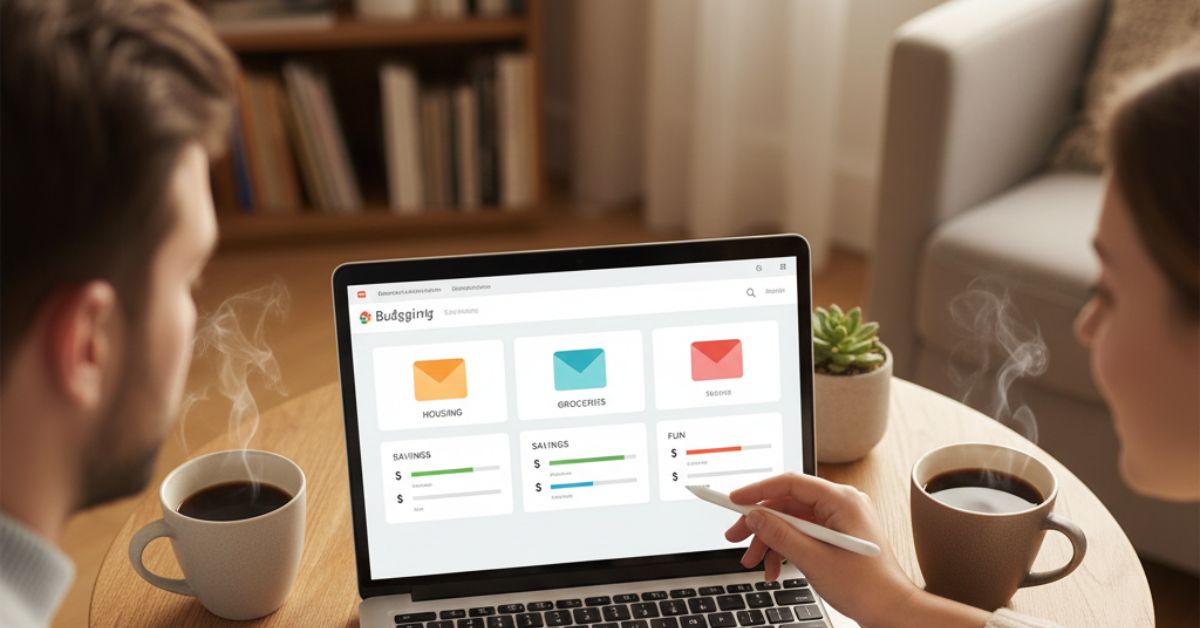
Digital envelope system is a modern budgeting method that pairs traditional cash-envelope discipline with digital tools to manage household finances. In this article you’ll learn how couples can use a digital envelope system to run money meetings that keep both partners aligned, reduce conflict, and reach shared goals.
Key takeaways
-
A digital envelope system organizes money into virtual “envelopes” (categories) so every dollar has a purpose.
-
Couples’ money meetings plus a digital envelope system improve transparency, reduce arguments, and increase savings.
-
Start with a simple set of envelopes, automate transfers, and meet regularly (monthly or biweekly).
-
Track a few metrics: envelope coverage days, savings rate, and progress to goals.
-
Avoid micromanaging daily purchases; focus meetings on decisions and adjustments.
-
For irregular income, fund envelopes by percentage rather than fixed amounts.
-
Security: use two-factor authentication and bank-level apps for shared accounts.
What is a digital envelope system?
A digital envelope system (DES) is the electronic version of the cash-envelope method: create virtual categories, allocate funds, and track balances so money only gets spent in its intended category. You can implement this with bank subaccounts, budgeting apps that offer envelope features, or a shared spreadsheet with clear tagging and reconciliation.
Why does a digital envelope system matter for couples?
Couples who use a digital envelope approach see clearer expectations and fewer money fights because allocations make intentions explicit. A visible allocation of funds transforms vague intentions into measurable budgets, so both partners look at the same numbers in real time. Government and industry data show that households that monitor spending and use budgeting practices manage shocks better and have clearer savings behavior.
How do couples start a digital envelope system for budgeting?
Step-by-step setup
-
Schedule a recurring money meeting. Pick a consistent time—monthly or biweekly—and treat it like a brief business check-in.
-
Pick your tool. Choose bank subaccounts, a budgeting app, or a shared spreadsheet. Prioritize shared access and automation.
-
Create 6–8 envelopes. Essentials: housing, groceries, transportation, emergency, savings goals, and fun. Keep it simple at first.
-
Allocate and automate. Transfer money into envelopes or tag transactions automatically after payday. Set rules for overspend and transfers.
-
Review and adjust. At each meeting, check balances and tweak allocations as needed.
How to run effective couples’ money meetings?
Meeting flow (20–30 minutes)
-
Start positively: say one compliment or financial win.
-
Share updates: brief balances and any large expenses.
-
Review envelopes: flag underfunded categories.
-
Plan: make small, specific decisions (e.g., move $200 to emergency).
-
End with appreciation and next steps.
Helpful scripts
-
“Help me understand your thinking on this purchase.”
-
“Can we agree to move $X from fun to groceries this month?”
-
“I want to hear your concerns before I share mine.”
Examples and scenarios
Practical uses
-
Monthly rent and bills: fund a joint “housing” envelope from both paychecks.
-
Vacation savings: automate contributions into a “vacation” envelope.
-
Seasonal costs: create envelopes for irregular bills (car insurance, holiday gifts) and fund them monthly.
Comparison table: cash envelopes vs digital envelope approach
| Feature | Cash envelope | Digital envelope approach |
|---|---|---|
| Visibility to partner | Low | High — shared balances |
| Security | Physical risk | Bank-level security |
| Automation | Manual | Can automate transfers |
| Flexibility | Hard to split | Easy to split and track |
| Record keeping | Paper receipts | Automatic transaction tagging |
What mistakes should couples avoid?
-
Skipping meetings — without regular reviews, envelopes drift.
-
Micromanaging — avoid arguing over single small purchases; focus on trends.
-
Too many envelopes — complexity reduces follow-through.
-
No automation — manual funding often fails.
-
Mixing personal and joint funds — label accounts and categories clearly.
How does the system perform long-term?
A consistent budget method increases the chance of hitting savings goals and lowers money-related stress. Many people struggle to follow budgets: industry reporting indicates a gap between claiming to budget and actually sticking to it, so the system’s automation and shared visibility help close that gap. Investopedia Over time, the process builds a shared financial language that makes larger decisions—buying a home, having children—less adversarial.
Can couples use this with irregular income or gig work?
Yes. Use percentage-based allocations: each income event funds essentials, savings, and envelopes by agreed percentages. Maintain a buffer envelope worth one pay period to smooth low-income months.
What tools or automations help the most?
Automation checklist
-
Scheduled transfers to envelope subaccounts the day after payday.
-
Automatic tagging of transactions for quick reconciliation.
-
Alerts for low envelope balances.
-
Shared views for both partners.
Expert insight or statistic
Federal Reserve data shows that a significant share of adults report setting aside money for emergency funds, which underscores the value of disciplined budgeting and envelope-style buffers for unexpected expenses.
What should you track each meeting?
-
Envelope coverage days: how long remaining funds will last at current spending.
-
Savings rate: percent of income allocated to goals.
-
Goal progress: percent funded for each big goal.
-
One action taken: whether committed automations or transfers were executed.
Conclusion + next steps
A small, consistent habit—one short meeting, a few simple envelopes, and one automated transfer—often produces outsized results. Start with three envelopes, schedule your first 20–30 minute check-in, and automate one contribution after payday. Consistency compounds: clarity and shared rules will turn money from a conflict source into a partnership tool.
References
-
Federal Reserve, Economic Well-Being of U.S. Households in 2024, June 12, 2025.
-
Investopedia, “How Many People Actually Stick to a Budget?” (budget adherence and behavior).
-
U.S. Bureau of Labor Statistics, Consumer Expenditures and related reporting.
FAQs:
How often should couples meet about money?
Monthly or biweekly works well; choose a cadence you can sustain and keep meetings short and focused.
Can a digital envelope method work with joint accounts?
Yes — use subaccounts, tags, or shared app access to mimic envelopes inside a joint banking structure.
Are there free digital envelope system apps?
Several budgeting apps offer free tiers with envelope-like features; many banks also provide no-cost subaccounts or tagging tools.
What if one partner hates tracking every purchase?
Start with high-level envelopes (essentials, savings, fun) and avoid daily nitpicking; focus meetings on big-picture goals.
What’s the best app or tool to use?
“Best” depends on preferences (automation, shared access, privacy). Prioritize apps that allow shared views, automations, and envelope-style allocations.