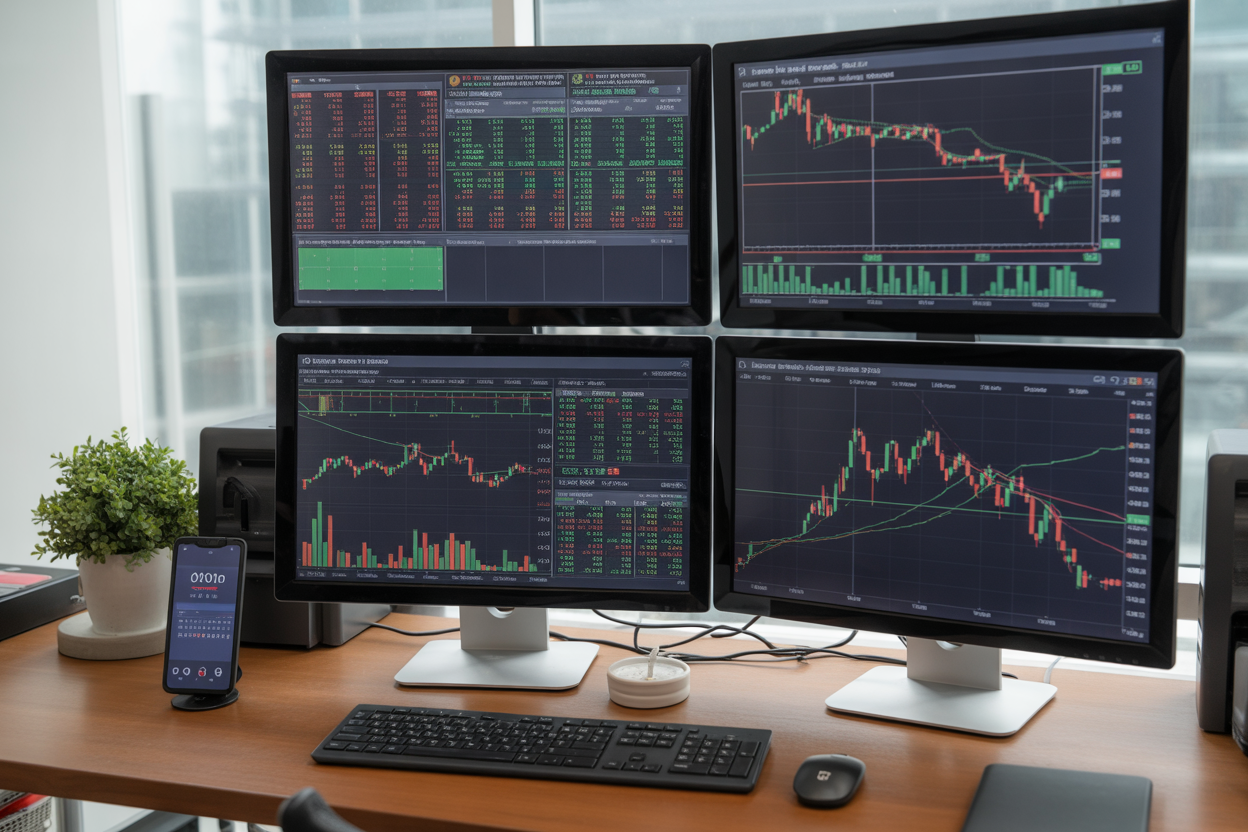
Forex trading is the global practice of buying and selling currencies to profit from changes in exchange rates. It is the largest financial market in the world, operating 24 hours a day across major time zones and offering high liquidity and rapid price movement. In this guide you’ll learn what forex trading is, why it matters, how to start safely, common pitfalls to avoid, and where to find reliable tools and brokers.
Key Takeaways
-
Forex trading is the exchange of one currency for another to profit from price movements.
-
The forex market averaged about $7.5 trillion in daily turnover in 2022.
-
Traders use spot, forward, and derivative instruments, often via brokers or trading apps.
-
Risk management and a clear plan are essential; leverage magnifies both gains and losses.
-
Beginners should practice on demo accounts and prioritize education and regulated brokers.
-
Live charts, economic calendars, and news feeds are core tools for real-time trading decisions.
-
Choose a broker with transparent fees, strong regulation, and reliable execution.
What Is Forex Trading?
Forex trading (foreign exchange trading) involves exchanging one nation’s currency for another. Trades occur in pairs — for example, EUR/USD — where the first currency (base) is bought or sold against the second (quote). Traders aim to profit from changes in the exchange rate between the two currencies.
Market structure and participants
The market is over-the-counter (OTC), meaning trades happen directly through banks, brokers, and electronic platforms rather than on a single exchange. Major participants include central banks, commercial banks, institutional investors, corporations, hedge funds, and retail traders using broker platforms or forex trading apps.
Instruments you can trade
Common instruments include spot FX (immediate exchange), forwards (agreements to exchange at a future date), and FX derivatives like futures and options. Retail traders mostly use margin accounts and CFDs or spot accounts provided by brokers.
Why Does Forex Trading Matter?
Forex trading matters because it supports global trade, cross-border investment, and currency risk management. For individual traders, forex trading offers round-the-clock opportunity, deep liquidity, and access to leverage.
Market size and liquidity
The foreign exchange market is the most liquid in the world, with daily trading activity averaging about $7.5 trillion in 2022. That volume means traders can enter or exit positions quickly at market prices.
Economic significance
Currencies reflect macroeconomic trends, interest-rate differentials, and geopolitical events. Traders use economic calendars, central bank announcements, and data releases to anticipate volatility.
How to Start Forex Trading
Beginning forex trading requires education, a trading plan, and tools. Follow these steps to start responsibly.
Step-by-step beginner checklist
-
Learn the basics: Study currency pairs, pips, lots, margin, and leverage.
-
Choose a regulated broker: Look for brokers overseen by reputable regulators and transparent about fees.
-
Open a demo account: Practice with virtual funds to learn platforms and live charts.
-
Develop a trading plan: Define timeframes, risk per trade, entry/exit rules, and performance review processes.
-
Start small: Use low leverage until you gain consistent results.
-
Use risk management: Set stop-loss orders, size positions appropriately, and diversify strategies.
Choosing a platform and app
A good forex trading app provides real-time quotes, a live charting package, fast order execution, and secure fund handling. Confirm the app connects to a regulated brokerage and offers demo accounts and customer support.
Can You See Examples or Scenarios?
Example 1: Short-term trade on EUR/USD
A trader believes the euro will strengthen after a favorable inflation report. They buy EUR/USD, place a stop loss to limit downside, and set a profit target. If the pair reaches the target, the trade yields a positive return minus spreads and fees.
Example 2: Hedging for a business
An importer expecting to pay foreign suppliers in three months enters a forward contract to lock in today’s exchange rate, reducing budget uncertainty.
Comparison table: Spot vs Forward vs Futures
| Feature | Spot | Forward | Futures |
|---|---|---|---|
| Settlement | Immediate | Future date | Traded on exchange |
| Use case | Speculation, liquidity | Hedging specific exposure | Speculation, standardized hedging |
| Counterparty | Broker/bank | OTC contract | Exchange-cleared |
What Mistakes Should You Avoid in Forex Trading?
Forex trading can be fast and risky. Avoid these common errors.
Overleveraging
High leverage can inflate returns but also magnifies losses. Use leverage conservatively and know the broker’s margin rules.
Trading without a plan
Random trades driven by emotion lead to inconsistent results. Define rules before entering trades and stick to them.
Ignoring risk management
Always use stop losses, limit position sizes to a small percentage of capital, and set realistic expectations.
Chasing news or rumors
Forex responds quickly to news; reacting impulsively to every headline leads to whipsaw losses. Rely on verified data and controlled responses.
What Are the Long-Term Benefits or Impact of Learning Forex Trading?
Studying forex trading builds financial literacy, technical analysis skills, and macroeconomic understanding. Even if you don’t trade full-time, knowledge of currencies helps with personal finance, travel, and investing.
Skill transfer and discipline
Disciplined trading strategies translate to better decision-making in other investments. Long-term traders often develop robust routines for research, journaling, and risk control.
Conclusion:
Forex trading offers global access to currency markets, strong liquidity, and the possibility of profit—but it carries significant risks. Start with education, practice on a demo account, choose a regulated forex trading broker or app, and prioritize risk management. Over time, a disciplined approach and clear plan can help you trade more consistently.
Expert Insight or Statistic
The Bank for International Settlements’ Triennial Survey reported average daily FX turnover of about $7.5 trillion in April 2022, illustrating the market’s size and liquidity. This scale helps ensure tight spreads and deep liquidity for most major currency pairs.
FAQs
How does forex trading work for beginners?
Beginners buy and sell currency pairs through a broker, using margin accounts; they learn to read pips, manage leverage, and use charting tools to find entry and exit points.
What should I look for in a forex trading broker?
Choose brokers with strong regulation, transparent fees, reliable execution, demo accounts, and responsive customer support.
Can I use a forex trading app for serious trading?
Yes—many reputable brokers offer mobile apps with live charts and order entry; ensure the app is from a regulated broker and supports risk controls.
What is the easiest currency pair to trade?
Major pairs like EUR/USD or USD/JPY are typically the most liquid and have narrower spreads, making them popular choices for beginners.
Is forex trading risky?
Yes—forex trading involves significant risk due to leverage and volatility; disciplined risk management and education are essential to limit losses.