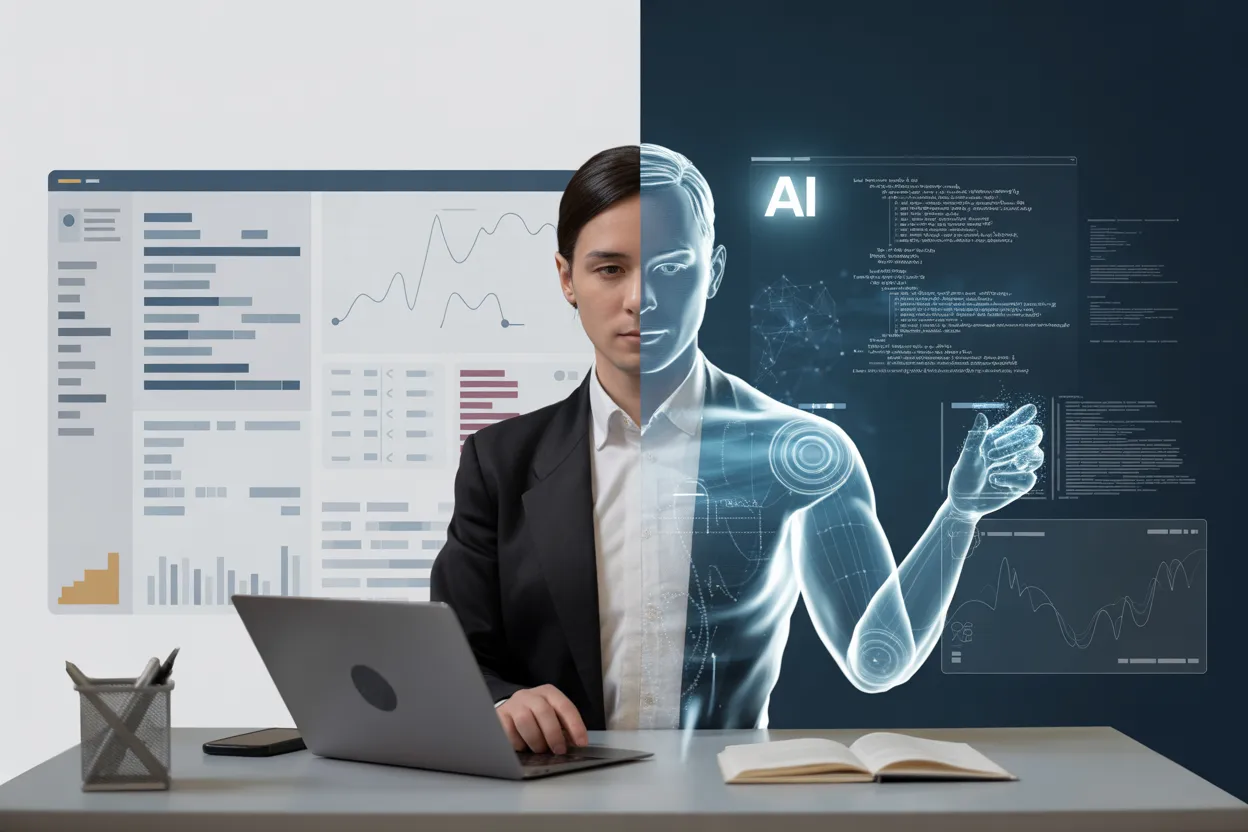
Direct Answer The shift from software as a tool to software as a collaborator changes workforce dynamics by moving the human role from “operator” to “manager.” In a tool-based environment, humans perform the work using software to increase efficiency. In a collaborative environment, the software independently generates drafts, solves problems, and executes tasks, while the human provides oversight, quality control, and strategic direction.
How It Works Traditional software functions as a passive instrument, like a hammer or a spreadsheet. It requires a human to input every command and make every decision. The output is a direct result of the user’s manual manipulation of the interface. This creates a linear relationship where the speed and quality of work are strictly limited by the human’s active participation.
Collaborative software utilizes generative and agentic AI to act as a proactive partner. It can suggest improvements, identify errors before they are pointed out, and perform background research while the user works on other tasks. This creates a parallel workflow where the human and the software are contributing to the same project simultaneously. The software no longer just stores or formats data; it “reasons” through it to provide meaningful contributions.
This transition requires a fundamental change in skill sets. Instead of focusing on technical proficiency within a specific software interface, workers must develop skills in delegation, prompt engineering, and critical evaluation. The software becomes an “intern” or “teammate” that requires clear instructions and rigorous checking, rather than a silent tool that only does exactly what a button press dictates.
Real-World Implications
- Role Redefinition: Jobs previously centered on data entry or basic synthesis are evolving into roles centered on auditing and refining AI-generated outputs.
- Reduced Barrier to Entry: Collaborative software allows individuals without deep technical training to perform complex tasks, such as coding or graphic design, by collaborating with the AI.
- Accelerated Innovation: Teams can move from idea to prototype much faster when software handles the heavy lifting of initial drafting and technical execution.
Signals to Monitor
- Management Training: Increases in corporate training focused on delegating to and managing AI systems rather than just using them.
- Output Volume: Shifts in the expected quantity of work per employee as software begins to handle more of the production cycle.
- Error Attribution: Developments in legal and corporate policy regarding who is responsible when a collaborative AI makes a mistake.
Comparison Table:
| Aspect | Software as a Tool | Software as a Collaborator |
|---|---|---|
| Human Role | Operator | Manager / Strategist |
| Workflow Style | Linear (human-led) | Parallel (human + AI) |
| Decision Making | Fully human-controlled | Shared (AI suggests, human approves) |
| Skill Requirements | Technical proficiency | Delegation, prompt engineering, critical thinking |
| Speed of Output | Limited by human effort | Accelerated through AI automation |
| Error Detection | Human identifies errors | AI identifies + human verifies |
| Innovation Pace | Gradual | Rapid prototyping and iteration |
| Responsibility | Clearly human | Shared oversight, complex attribution |
Final Thoughts
The transition from software as a tool to software as a collaborator marks one of the most significant shifts in modern workforce dynamics. This is not simply an upgrade in productivity software—it is a structural change in how work gets done.
When software functions as a tool, human effort determines speed, scale, and quality. But when software becomes a collaborator, work transforms into a shared process. AI systems draft, analyze, suggest, and execute—while humans guide, evaluate, and refine. The value of employees increasingly lies not in performing repetitive tasks, but in judgment, creativity, and strategic oversight.
Organizations that recognize this shift early will gain a competitive advantage. They will invest in AI literacy, redefine job roles around supervision and decision-making, and build governance systems that clarify accountability. At the same time, individuals who develop skills in delegation, critical evaluation, and AI collaboration will remain highly relevant in this evolving landscape.
Ultimately, the future of work is not about humans versus software. It is about humans working alongside intelligent systems. The companies and professionals who learn to manage software as a collaborator—rather than merely use it as a tool—will shape the next era of productivity and innovation.
FAQs
1. What does “software as a collaborator” mean?
Software as a collaborator refers to AI-powered systems that actively generate ideas, drafts, solutions, and improvements rather than simply executing commands. Unlike traditional tools, collaborative software works alongside humans as a proactive partner, contributing meaningful outputs instead of just processing inputs.
2. How does collaborative software change workforce roles?
Collaborative software shifts workers from operators to managers. Instead of manually performing every task, employees oversee AI-generated outputs, refine results, provide strategic direction, and ensure quality control. The focus moves from execution to supervision and decision-making.
3. What new skills are required in an AI-collaborative workplace?
The most important skills include prompt engineering, delegation, critical evaluation, and strategic thinking. Workers must know how to guide AI systems effectively and verify outputs. Technical interface mastery becomes less important than the ability to manage AI as a teammate.
4. Does collaborative software eliminate jobs?
Collaborative software does not necessarily eliminate jobs, but it transforms them. Routine and repetitive roles may decline, while jobs centered on creativity, oversight, innovation, and AI management grow. The workforce shifts rather than disappears.
5. Who is responsible when AI makes a mistake?
In most cases, responsibility remains with the human or organization overseeing the AI system. However, legal frameworks and corporate policies are evolving to clarify accountability in AI-assisted environments, especially when decisions are partially automated.