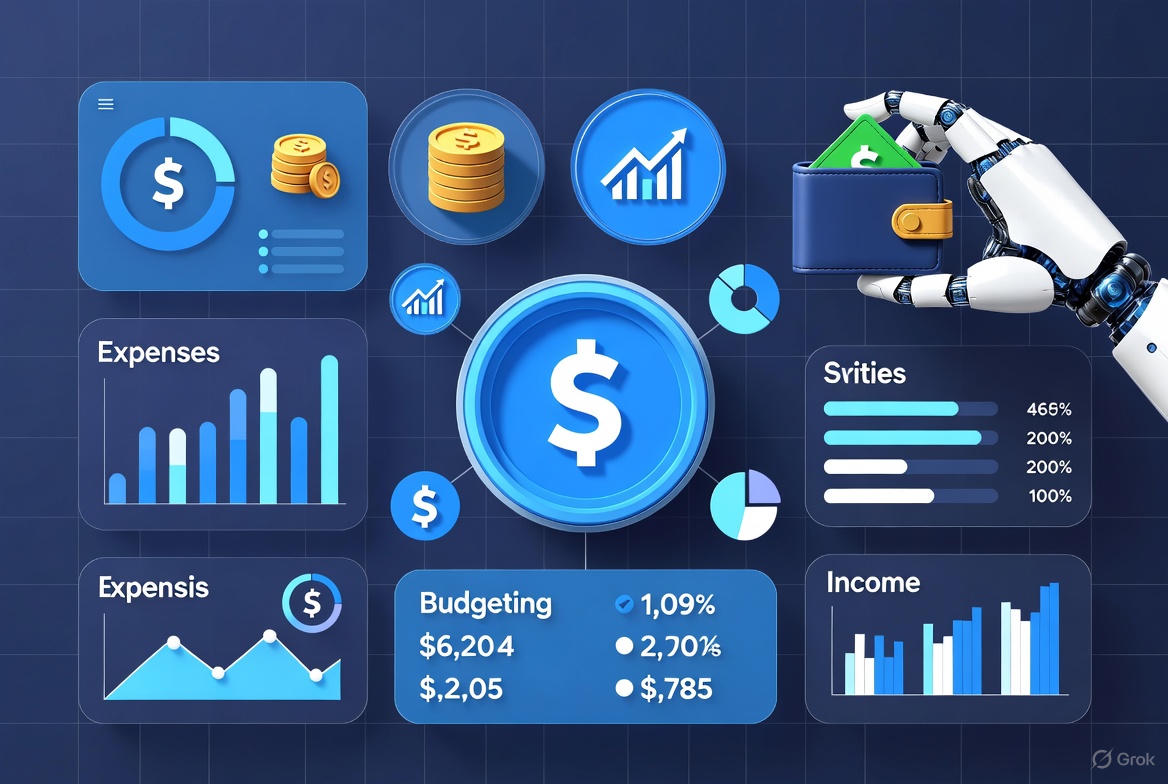
AI budgeting app are reshaping personal finance by automating expense tracking and offering personalized advice from the first login. In this guide you will learn what an AI budgeting app does, why it matters, and how to pick one that fits your life.
Key Takeaways
-
An AI budgeting app reduces manual categorization and surfaces subscription waste quickly.
-
AI budgeting tools identify trends and help set realistic savings goals.
-
A smart budgeting app shows “safe to spend” amounts after bills and goals.
-
Verify privacy controls and encryption before trusting an AI personal finance app with sensitive data.
-
Many automated budgeting app features require a paid plan for full functionality.
-
Combine an AI budgeting app with a written financial plan for best results.
What Is AI budgeting app?
An AI budgeting app connects to your bank and card accounts, aggregates transactions, and uses machine learning to classify spending. It streamlines bookkeeping tasks like reconciling activity, tracking recurring bills, and assigning money to categories. Popular apps include YNAB, Cleo, Rocket Money, Monarch, PocketGuard, Albert, and Personal Capital (Empower).
Why Does AI budgeting app Matter?
AI budgeting app matters because it saves time and uncovers patterns people often miss. With automated categorization and spending insights, users can reduce late fees, cut recurring costs, and make faster progress on debt and savings goals. The FINRA Foundation’s National Financial Capability Study (2025) reports that roughly 42% of adults use websites or apps for budgeting, saving, or credit management — a sign that digital financial tools are mainstream.
How to use an AI budgeting app
Step-by-step setup
-
Define your top goal (save emergency fund, stop subscription waste, track investments).
-
Choose one app that matches that need.
-
Link a single checking account first; confirm categorization.
-
Add credit cards and other accounts once labeling is accurate.
-
Set budgets, goals, and alerts, then review weekly.
What to compare
-
Automated categorization accuracy and correction workflow.
-
Subscription detection and cancellation options.
-
Goal-tracking tools and reporting exports (CSV/PDF).
-
Encryption, data sharing policy, and two-factor authentication.
Matching features to goals
-
Beginners who want simplicity: safe-to-spend features.
-
Subscription hunters: recurring-charge detection.
-
Planners: zero-based budgeting and forward planning.
-
Investors: net-worth and portfolio aggregation.
What are common examples and scenarios for an AI budgeting app?
Comparison table: Use cases at a glance
| Use Case | Best for | Example feature |
|---|---|---|
| Day-to-day cash control | Beginners | Safe-to-spend indicator |
| Cancel unwanted recurring fees | Cost-conscious users | Subscription scanner + cancel service |
| Track net worth | Investors | Investment aggregation |
| Zero-based budgeting | Planners | Assign every dollar a job |
| Shared finances | Couples | Shared categories and joint goals |
Scenario: If you suspect you’re overspending on streaming, an AI budgeting app with subscription detection will list recurring charges, flag small annual fees, and (in some apps) offer cancellation. Always confirm suggested cancellations before they execute.
What mistakes should I avoid with an AI budgeting app?
-
Linking all accounts at once — test with one account first.
-
Giving more permissions than necessary — prefer read-only access.
-
Expecting perfect categorization — correct and teach the app.
-
Ignoring privacy settings — review the app’s data sharing policy.
-
Letting automation replace judgment — use insights, not autopilot.
What long-term benefits does an AI budgeting app offer?
Used consistently, these tools build savings habits, lower unnecessary fees, and give clarity to net worth over time. Behavioral wins are the biggest payoff: automation reduces friction, and visible progress reinforces good decisions. Over years, the combination of automated tracking, proactive bill reminders, and smart goal nudges can materially improve cash flow and financial confidence.
What are the next steps after choosing an AI budgeting app?
-
Start with a single goal and one linked account.
-
Enable security features (2FA, biometric lock).
-
Run weekly checks and a monthly report export.
-
Adjust categories and goals as you learn.
-
Consider upgrading to a paid tier only if the additional features directly support your goals.
Expert Insight
Digital tools are already a major part of money management; the FINRA Foundation’s 2025 study (National Financial Capability Study) documents widespread use of apps and websites for budgeting tasks, underscoring how AI-driven features fit into current consumer behavior.
FAQs
What is the best AI budgeting app for beginners?
Look for apps that simplify decisions and show “safe-to-spend” numbers; PocketGuard and Cleo are known for approachable, guided interfaces.
Can an AI budgeting app save me money?
Yes — by identifying recurring charges and suggesting adjustments, many AI budgeting tools reduce wasteful spending.
Are AI personal finance apps secure?
Reputable apps use encryption and industry-standard security; always read privacy policies and enable two-factor authentication.
Do AI budgeting apps work with multiple banks?
Most connect to many institutions via secure aggregators; check the specific app’s supported bank list before signing up.
Will an automated budgeting app replace my financial advisor?
No — tools are excellent for daily management and insights; human advisors remain better for complex tax, estate, or investment planning.