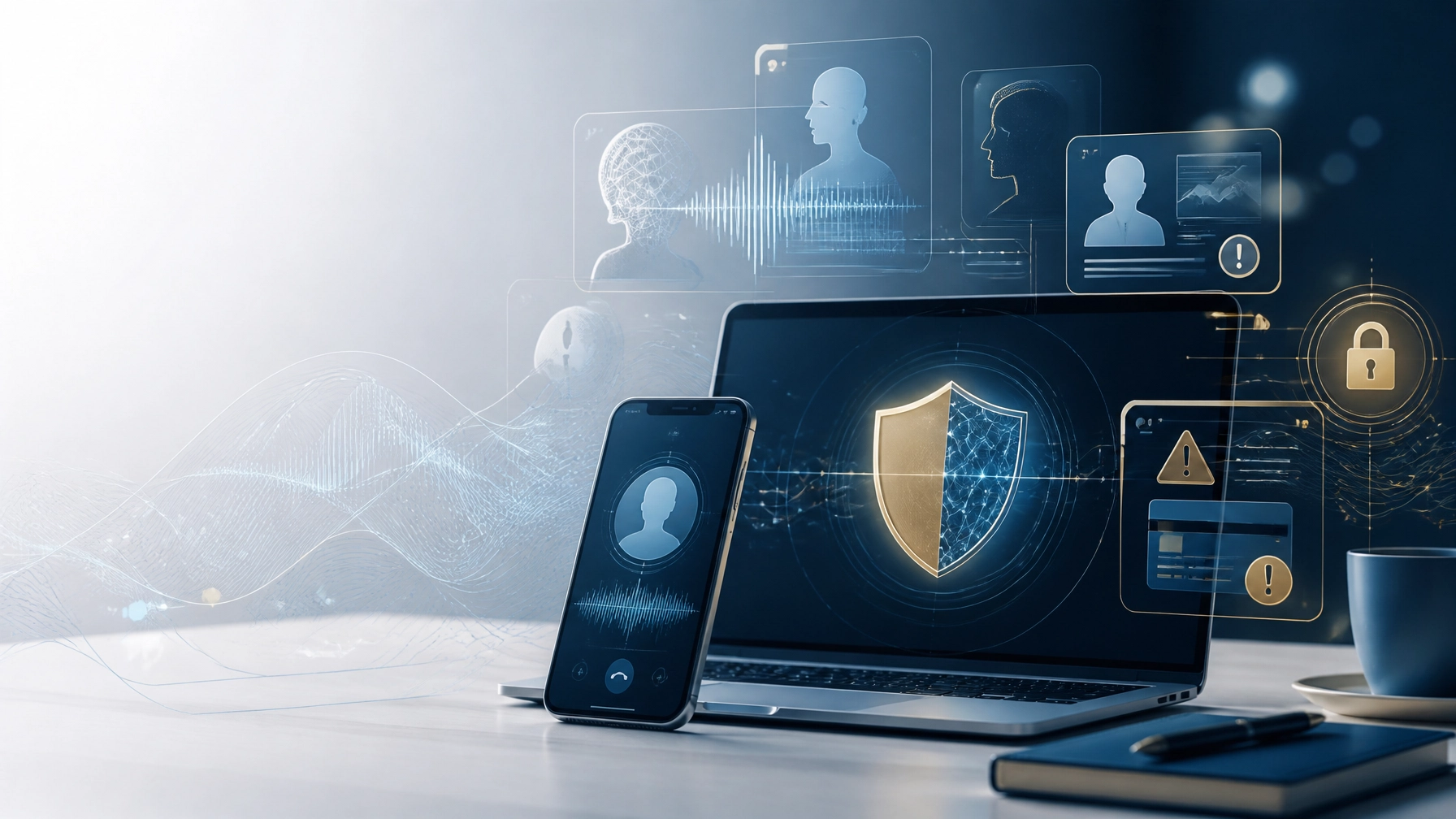
Scammers have always relied on deception. Artificial intelligence now helps them produce that deception faster, more cheaply, and at greater scale.
A fraudulent message can be written in polished language. A fake customer-service representative can sound convincing on the phone. A fabricated social media profile can build credibility over weeks or months. Scammers may even use AI influencers and fake influencers to promote fraudulent investment schemes, financial coaching offers, or online businesses.
At the same time, financial institutions and identity-verification companies are deploying artificial intelligence to identify suspicious activity, analyze transactions, and investigate fraud alerts in real time.
This creates an AI-versus-AI fraud arms race. Your bank’s security systems may become more capable, but your judgment remains an important part of the defense.
What the AI fraud arms race means
Tech Times reported on an identity-verification firm that raised capital and acquired another company to deploy AI agents against the growing volume of fraud attempts. The coverage attributed an 8,000% increase in AI-generated fraud attempts on that company’s network to the previous year.
That figure describes the firm’s own network and should not be treated as a universal measurement of all fraud. It does, however, illustrate the direction of the threat: fraudsters are using AI to create convincing identities, messages, voices, and documents at scale.
Defensive AI systems are being designed to review identity information, transaction patterns, watchlists, account activity, and other evidence. Some systems can assemble a case for a human investigator to review instead of requiring an employee to begin every investigation from scratch.
For everyday account holders, this may produce several changes:
- Suspicious transactions may be flagged more quickly.
- Legitimate purchases may occasionally be delayed or declined.
- Financial institutions may ask more questions when account behavior changes.
- Scammers may create more convincing messages that pass a quick visual or verbal inspection.
- A familiar voice or professional-looking profile will no longer be reliable proof of identity.
The key lesson is simple: appearance is not authentication.
How AI-powered fraud schemes work
AI does not need to make a scam completely original. It makes familiar scams more believable and easier to scale.
A scammer might use AI to:
- Write personalized phishing emails and text messages.
- Translate messages into natural-sounding language.
- Create realistic profile photos and biographies.
- Generate a voice that resembles a relative, manager, or service representative.
- Produce fake documents, invoices, or account notices.
- Operate multiple conversations at the same time.
- Test which messages create the strongest emotional response.
- Promote a fraudulent opportunity through AI influencers or fake influencers.
The targets can include anyone with money, credit, personal information, or access to a business account. Older adults may be targeted by impersonation schemes, while younger adults may encounter fake investment communities, employment offers, romance scams, or social-media promotions. Families, remote workers, side hustlers, and small-business owners may face payment-change requests that appear to come from someone they know.
The technology may change, but the psychological tactics remain familiar: trust, fear, urgency, and confusion.
Use the Identity, Proof, Channel, and Pressure tests
When a message involves money, personal information, account access, or a request to keep something secret, apply four tests before taking action.
1. Identity: Who is contacting you?
Do not assume that a familiar name, telephone number, email address, profile photo, or voice proves identity. Caller ID can be manipulated. Social media profiles can be fabricated. A voice can be imitated.
Verify the person or organization through an independent channel.
For example:
- Call the number printed on your debit or credit card.
- Open the financial institution’s app directly instead of using a message link.
- Contact a family member through a number already saved in your phone.
- Speak with a supervisor or colleague in person when a workplace payment request seems unusual.
Do not use the contact information provided in the suspicious message. That information may lead directly back to the scammer.
2. Proof: What evidence supports the request?
A convincing story is not proof. Ask what can be independently verified before you send money, disclose information, or approve a transaction.
Useful questions include:
- Can I confirm this request through an official account?
- Is there a written notice I can verify independently?
- Does the payment destination match the person or organization involved?
- Can I pause and consult someone I trust?
- Would a legitimate institution allow me time to verify the request?
Be cautious with screenshots, documents, badges, and testimonials. AI tools can create professional-looking materials that have no legitimate connection to the organization they appear to represent.
3. Channel: How did the request arrive?
The communication channel provides important context.
Be especially cautious when a request arrives through:
- An unsolicited phone call
- A direct message on social media
- A messaging app
- An unexpected text or email
- A newly created online profile
- A personal account instead of an official business channel
A legitimate institution may contact you through many channels, but you should still verify the request independently. Treat unusual combinations as a warning, such as a caller asking you to move a conversation to a private messaging app or a supposed financial professional insisting that all communication remain on social media.
4. Pressure: Why must you act immediately?
Urgency is one of the strongest scam signals.
A caller may claim that your account will be closed, your identity has been compromised, or a loved one is in danger unless you act immediately. An investment promoter may say that an opportunity expires within minutes. A supposed government representative may threaten fines or arrest.
Legitimate institutions rarely demand instant payment through gift cards, cryptocurrency, cash, or an irreversible wire transfer. They also should not ask you to disclose a one-time passcode to “secure” your account.
Pause the transaction. Pressure is not proof.
Account-protection steps that reduce your exposure
Security habits cannot eliminate risk, but they can reduce the financial damage when a scam attempt occurs.
Enable multi-factor authentication
Turn on multi-factor authentication for banking, email, social media, payment, and investment accounts. When possible, consider an authenticator app or security key instead of relying only on text messages.
Never share a one-time passcode with someone who contacts you unexpectedly. If you receive a code you did not request, do not approve the login or read the code to anyone. Contact the institution through a trusted channel.
Set transaction and login alerts
Use alerts for:
- Purchases above a chosen amount
- New payees
- Transfers and withdrawals
- Password or contact-information changes
- New-device logins
- Low balances
- International transactions
Alerts turn account monitoring into an early-warning system. They also help you distinguish between a genuine security notification and a scammer’s claim about what supposedly happened.
Create a family codeword
Families can establish a private codeword for emergencies involving money or travel. The codeword should not be a birth date, pet name, address, or information visible on social media.
A codeword is not a substitute for verification, but it can help expose an impersonation attempt involving a child, grandchild, spouse, or parent.
Review statements and credit activity
Check bank and credit card activity regularly. Look for small unfamiliar charges, new payees, changed contact details, and withdrawals that do not match your records.
Small transactions may be used to test whether an account is active. Early reporting gives your financial institution a better opportunity to block additional activity or attempt recovery.
For more guidance, review Ask The Money Coach resources on identity theft prevention, protecting your Social Security number online, and checking the legitimacy of online side gigs.
What to do if you responded to a scam
Act quickly, but do not let embarrassment delay you. Scam victims often lose more money because they wait to report the incident.
- Contact your bank, credit union, card issuer, payment provider, or cryptocurrency platform immediately. Ask whether the payment can be stopped, recalled, or disputed.
- Change the affected password. Change it anywhere else you reused it.
- Sign out of unfamiliar devices and review account-recovery settings.
- Reconfigure multi-factor authentication if an account or phone number may have been compromised.
- Contact your mobile carrier if you suspect a SIM-swap or unauthorized change to your phone service.
- Preserve messages, email headers, phone numbers, payment confirmations, wallet addresses, and screenshots.
- Report the incident to the FTC at ReportFraud.gov.
- File an online-fraud complaint with the FBI Internet Crime Complaint Center.
- If your Social Security number or other identity information was misused, use IdentityTheft.gov for a personalized recovery plan.
- Consider a fraud alert or credit freeze if your personal information may have been exposed.
The FTC explains that recovery options vary by payment method. Credit and debit card transactions may have protections that are not available for cryptocurrency, gift cards, cash, or some transfers. The sooner you contact the provider, the more options you may have.
Government and consumer-protection resources
Use official websites and contact information when reporting fraud:
- FTC ReportFraud.gov: Report scams and receive consumer guidance.
- FBI IC3: Report internet-enabled fraud and account-takeover activity.
- IdentityTheft.gov: Report identity theft and receive a recovery plan.
- FTC guidance on what to do after being scammed: Review payment-specific recovery steps.
Remember that no financial institution or government agency should demand that you transfer money to “protect” it. That request is itself a warning sign.
Final takeaway
AI may make fraud attempts more polished, personal, and persistent. It may also help financial institutions detect suspicious behavior faster. But defensive technology works best when consumers slow down long enough to verify what they are being told.
Before acting, test the Identity, Proof, Channel, and Pressure of the request. Use multi-factor authentication, enable alerts, protect one-time passcodes, and review your accounts consistently.
You do not need to identify whether a message was written by AI. You only need to decide whether the request is independently verified, financially reasonable, and safe to follow.
FAQs: AI Fraud Scams
1. What is an AI fraud scam?
An AI fraud scam uses artificial intelligence to make deception more convincing or scalable. Examples include realistic phishing messages, cloned voices, fake profiles, fabricated documents, and automated conversations designed to obtain money or personal information.
2. Can a scammer really imitate someone’s voice?
Voice imitation technology can produce audio that resembles a real person. A familiar voice should not be treated as complete proof of identity. Verify the request through a separate phone number, video call, known account, or another trusted method.
3. How do I know whether an online influencer is legitimate?
Do not rely only on follower counts, polished videos, testimonials, or apparent expertise. Verify the person’s identity, check whether claims can be independently supported, and be cautious when an influencer promotes guaranteed returns, private payment methods, or pressure to act quickly.
4. Are AI influencers and fake influencers always scams?
No. Some virtual or AI-generated influencers are legitimate forms of media and marketing. The warning sign is not the use of AI by itself. Risk increases when the profile promotes unrealistic financial results, requests payment through unusual channels, or discourages independent research.
5. What should I do if I receive an unexpected one-time passcode?
Do not share the code or approve a login. Access the account directly, review recent activity, change your password if needed, and contact the institution using a trusted phone number or official app.
6. Is multi-factor authentication enough to stop fraud?
No security measure is perfect. Multi-factor authentication can make account takeover more difficult, but scammers may try to trick you into sharing a code or approving a login. Treat authentication codes and approval prompts as confidential.
7. Why do scammers ask for gift cards or cryptocurrency?
These payment methods can be difficult to reverse and may provide limited consumer protection. A demand for gift cards, cryptocurrency, cash, or an urgent wire transfer should be treated as a serious warning sign.
8. Should I trust a caller because the number matches my bank?
No. Caller ID can be manipulated. End the call and contact the institution using the number on your card, statement, or official website.
9. Can my bank reverse money sent to a scammer?
Possibly, depending on the payment method, timing, and circumstances. Contact the financial institution or payment provider immediately and ask whether the transaction can be blocked, recalled, or disputed.
10. Where should I report an AI-enabled scam?
Report it to the FTC at ReportFraud.gov. For internet-enabled fraud, file a complaint with the FBI IC3. If your identity information was misused, use IdentityTheft.gov for recovery guidance.
Avoid This Scam™ is the consumer protection and scam awareness desk of AskTheMoneyCoach.com. We help readers recognize, avoid, and respond to financial scams, fraud, identity theft, deceptive business practices, and online threats.
Our coverage includes scam alerts, fraud prevention strategies, consumer advocacy, practical safety guides, and expert analysis designed to help individuals and families protect their money, personal information, and financial well-being. We also explain what to do if you’ve already been targeted, because knowing how to respond can be just as important as avoiding a scam in the first place.