When comparing forex brokers, one number can look especially appealing: 0.0 pips. If one broker advertises spreads “from 0.0” and another advertises something higher, it is tempting to assume the first broker must be cheaper.
Not necessarily. The word “from” matters.
A minimum advertised spread tells you the lowest spread that may be available under certain conditions. It does not necessarily tell you what traders typically encounter over the course of an ordinary trading day. That is why average forex spreads can be a more useful comparison point. They do not tell you everything about the cost of trading, but they can provide a more realistic picture than focusing only on the smallest number in an advertisement.
What Is a Forex Spread?
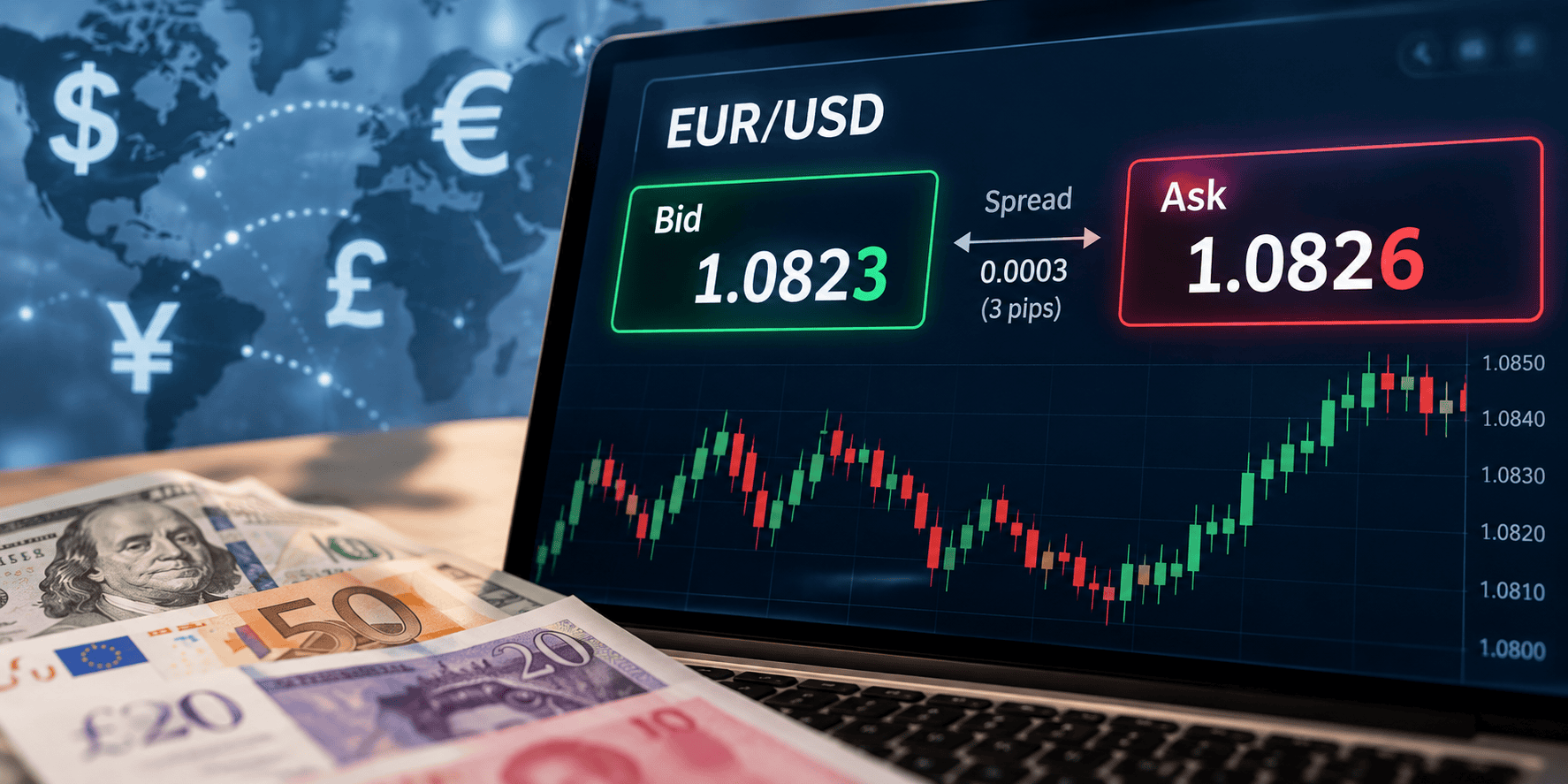
A forex spread is the difference between the price at which a currency pair can be bought and the price at which it can be sold. For example, if EUR/USD has a bid price of 1.1000 and an ask price of 1.1002, the difference is 0.0002, or two pips.
That spread is one component of the cost associated with entering and exiting a forex trade. The Commodity Futures Trading Commission notes that retail forex dealers may make money through spreads, commissions and other charges, which is one reason consumers should understand a broker’s pricing structure before opening an account.
What Does “Spreads From 0.0 Pips” Mean?
When a broker advertises spreads “from 0.0 pips,” it generally means the spread can reach zero under certain market conditions. It does not mean every trade will carry a zero spread.
Spreads can change based on the currency pair being traded, market liquidity, time of day, economic announcements, volatility, account type and the broker’s pricing structure. A minimum spread is therefore best understood as a best-case pricing point, not necessarily a representation of normal trading conditions.
Think of it like an airline advertising tickets “from $49.” A $49 seat may be available, but that number alone does not tell you what the typical passenger pays. The same principle can apply to forex spreads.
Why Average Forex Spreads Can Be More Useful
An average spread looks at pricing over a broader period rather than highlighting only the lowest observed spread.
Suppose two brokers both advertise spreads from 0.0 pips. On the surface, they appear identical. But imagine that over a defined period, Broker A averages 0.1 pips on EUR/USD while Broker B averages 0.6 pips. The minimum spread is the same, but the typical pricing experience is not.
That is why average or typical spread data can be valuable when comparing brokers. It helps answer a more practical question: What have traders generally been paying, rather than what is theoretically possible at the best moment?
Not All “Average Spread” Figures Are Created Equal
Average spread data is useful only if you understand what is being averaged. Before relying on an average figure, look for information about the time period measured, the currency pairs included, the account type measured, whether low-liquidity periods were excluded, whether the figures came from live accounts, whether a third party measured the data and whether commissions are charged separately.
A one-month average may look different from a six-month average. A calculation that excludes periods when spreads commonly widen can also produce a different result than one that includes every minute of the trading day.
The more transparent the methodology, the more useful the number becomes.
Why Forex Spreads Change
Forex spreads are not necessarily fixed. Liquidity and trading activity can vary throughout the day. When liquidity is high, spreads may tighten. When liquidity falls or uncertainty rises, spreads may widen.
This can happen around major economic reports, interest-rate decisions, geopolitical events, unusually volatile periods, daily rollover and times when major trading centers are less active. That means even an average spread should not be interpreted as a guarantee. It is a historical or representative measure, not a promise of the spread available on your next trade.
How Spreads Affect the Cost of Trading
A difference of a few tenths of a pip can seem insignificant, and for someone who trades infrequently it may be. For a trader who opens and closes positions regularly or trades larger volumes, however, small differences can accumulate over time.
That is why active traders often pay close attention to spread data. But a low spread does not make forex trading low-risk. The CFTC cautions that retail OTC forex trading carries substantial risk and that most retail customers lose money after financing charges, fees and other expenses are considered.
Trading costs and investment risk are two separate issues.
Look Beyond the Spread to the Total Cost of Trading
A broker with a lower spread is not automatically the less expensive broker.
Some trading accounts offer very tight or raw spreads but charge a separate commission. Others may build more of the broker’s compensation into the spread itself. Additional costs can include overnight financing or swap charges, currency-conversion charges, deposit or withdrawal fees and account fees, depending on the provider.
Execution quality matters too. Slippage — the difference between the price expected when an order is submitted and the price at which it is actually filled — is not the same as a stated commission or spread, but it can affect the effective result of a trade, particularly in fast-moving markets. Order execution, fill quality and the possibility of requotes or price changes therefore belong in a serious broker comparison.
The UK Financial Conduct Authority has similarly emphasized that the overall price of CFD trading can include bid-offer spreads, commissions and overnight funding charges.
Instead of asking only, “Which broker has the lowest spread?” a more useful question is: “What is the total cost and trading experience for the trades I expect to make?”
Minimum Spread vs. Average Spread: What Should You Compare?
Neither figure should be viewed alone. Ideally, traders should compare:
- Minimum spreads
- Average or typical spreads
- Commissions
- Overnight financing costs
- Execution quality and potential slippage
- The specific currency pairs they intend to trade
The methodology used to calculate reported averages
You should also consider factors unrelated to price, including regulation, account protections, withdrawal policies and the overall transparency of the provider.
A Real-World Example: TabTrade
TabTrade is one broker that publishes both minimum and average spread information rather than relying solely on a headline minimum.
For its Edge account, TabTrade reports spreads from 0.0 pips and an average of 0.04 pips across seven major forex pairs based on Datalyst measurements. On EUR/USD, TabTrade reports an average spread of 0.03 pips. The Edge account also charges a fixed commission of $3.50 per lot, per side, or $7 round turn.
That makes the all-in-cost principle easier to see. TabTrade calculates that a 0.03-pip EUR/USD spread on one standard 100,000-unit lot represents about $0.30 in spread cost. Add the $7 round-turn commission and the spread-plus-commission cost is about $7.30 — roughly the equivalent of 0.73 pips on a standard EUR/USD lot — before financing, slippage or other applicable charges.
That example illustrates why a headline spread should not be viewed in isolation. A trader looking only at “0.0” or “0.03” could miss part of the cost, while a trader looking only at the commission could miss differences in typical spreads.
The broader takeaway is not that a broker should automatically be chosen because it reports a particular average. It is that more complete pricing information makes a more meaningful comparison possible.
Readers who want to examine the underlying figures can review TabTrade’s published spread data and account terms directly before deciding whether its pricing structure fits their needs.
What Else Should You Look for When Choosing a Forex Broker?
Regulation and Jurisdiction
Understand which regulator oversees the broker and what protections apply to customers in your jurisdiction. The CFTC recommends that U.S. customers verify a retail forex dealer’s registration status and disciplinary history before depositing money.
Withdrawal Policies
Review how deposits and withdrawals work, including restrictions, processing requirements and fees.
Execution Conditions
Understand how orders are executed, whether pricing may change during volatile markets, and what information the broker provides about execution speed, slippage and order fills.
Account Structure
Compare minimum deposits, commissions, spreads, leverage, financing charges and other account-specific terms.
Transparency
The easier it is to understand what you may pay, how pricing is calculated and what can cause that pricing to change, the easier it becomes to compare providers on an informed basis.
Conclusion
A forex broker advertising spreads “from 0.0 pips” may be telling the truth, but that number alone does not tell you what trading will typically cost.
Average forex spreads can provide a more complete perspective because they reflect pricing across a broader set of market conditions. Even then, spreads are only one part of the comparison. Commissions, financing charges, execution quality, slippage, regulation and account terms can all matter.
Before choosing a forex broker, consider the average spread on the pairs you intend to trade, the methodology behind published pricing data and the other costs and protections associated with the account.
The goal is not simply to find the smallest number in an advertisement. It is to understand what you are likely to pay, what could cause that cost to change and what kind of trading environment you are choosing.
Frequently Asked Questions
What is a typical or average forex spread?
There is no single average spread that applies to the entire forex market. Spreads differ by currency pair, broker, account type, liquidity and market conditions. Major pairs such as EUR/USD often have tighter spreads than less frequently traded pairs. When comparing brokers, look for average or typical spread data for the specific pairs you intend to trade.
What is the difference between a minimum spread and an average spread?
A minimum spread is the lowest spread a broker may offer under certain conditions. An average spread represents spread measurements collected over a specified period. Because a minimum reflects a best-case point while an average reflects a broader sample, average spreads can provide additional context when comparing brokers.
Does a 0.0-pip spread mean trading is free?
No. A 0.0-pip spread does not necessarily mean a trade has no cost. Accounts offering zero or raw spreads may charge commissions, financing costs or other fees. Traders should compare the total trading cost rather than evaluating the spread alone.
How do you calculate total trading costs?
Start with the spread cost, then add any commission and other applicable charges. For positions held overnight, financing or swap charges may also apply. Execution differences such as slippage can affect the realized result even though they are not a stated fee.
What is a raw-spread forex account?
A raw-spread account generally provides pricing closer to underlying market spreads while charging a separate commission. This differs from some standard accounts, where more of the broker’s compensation may be incorporated into the spread. Compare the combined spread and commission rather than assuming a raw-spread account is automatically cheaper.
Is a broker with zero commission always cheaper?
A commission adds a separate charge to the spread. A broker offering a very low spread but charging a commission may ultimately cost more or less than a broker with a wider spread and no separate commission. The answer depends on account structure, currency pair, trade size and trading frequency.
Why do spreads widen during major news events?
Major economic releases and unexpected news can cause rapid changes in liquidity, trading activity and market uncertainty. Spreads may therefore widen during volatile periods compared with more typical market conditions.
Do forex spreads change throughout the day?
Yes. Forex market liquidity changes as major financial centers open and close. Spreads may be tighter during periods of heavier trading activity and wider during lower-liquidity periods or around daily rollover.
How should traders compare average spreads across brokers?
Compare average spreads on the same currency pairs and equivalent account types. Then evaluate commissions, financing charges, execution quality, regulatory oversight, withdrawal policies and other account terms. Avoid comparing one broker’s minimum spread with another broker’s average spread because the two figures measure different things.
Are spreads the most important factor when choosing a forex broker?
No. Trading costs matter, but regulation, account protections, execution quality, withdrawal practices, platform reliability and transparency can be equally important. A low advertised spread should be considered as one part of a broader broker evaluation.
This article is for educational purposes only and does not constitute investment, trading or financial advice. Forex and CFD trading involves significant risk and may not be suitable for all investors.

AskTheMoneyCoach Staff is the collective byline for our editorial team. Founded by Lynnette Khalfani-Cox, The Money Coach®, and Earl Cox, AskTheMoneyCoach.com publishes practical, research-informed guidance on credit, debt, saving, consumer protection, and everyday money decisions. Our work follows the site’s editorial standards and helps readers understand their options and make informed choices.