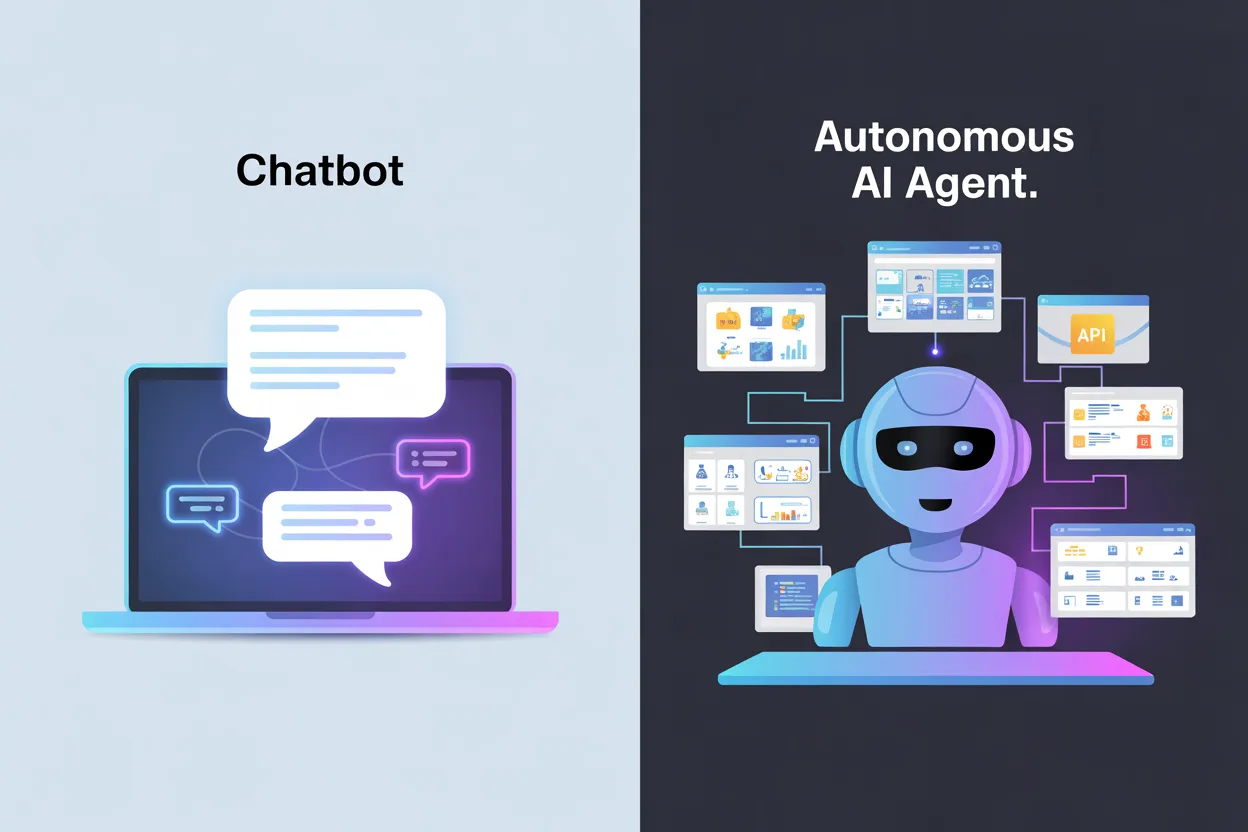
Direct Answer The primary difference between a chatbot and an autonomous AI agent lies in their operational intent and scope of action. A chatbot is a conversational interface designed to respond to specific user prompts by providing information or generating text within a dialogue. In contrast, an autonomous AI agent is a system designed to achieve a high-level goal by independently planning, executing, and adjusting a multi-step workflow without constant human intervention.
How It Works Chatbots typically operate on a request-response cycle. They utilize Natural Language Processing (NLP) to parse a user’s input and generate a relevant output based on their training data. While modern chatbots can maintain context over a conversation, they generally wait for a human to initiate each turn and do not take actions outside of the chat interface unless specifically triggered by a command.
Autonomous agents utilize a core reasoning model to act as a “brain” that oversees a broader loop. When given a complex objective, the agent decomposes that goal into a series of smaller sub-tasks. It then uses various tools—such as web browsers, code compilers, or API connectors—to execute those tasks. Throughout the process, the agent monitors its own progress and can self-correct or try new strategies if a particular step fails.
The distinction is essentially the difference between a consultant (the chatbot) and an employee (the agent). The consultant provides answers and advice when asked; the employee is given a project and works through the necessary steps to complete it, reporting back only when the task is finished or if a major roadblock occurs.
Real-World Implications
- Workforce Productivity: Agents can handle repetitive, multi-step digital processes, allowing human workers to focus on high-level strategy rather than task execution.
- System Integration: Agents bridge the gap between different software platforms by interacting with user interfaces just as a human would.
- 24/7 Operations: Unlike chatbots that require human prompts, agents can monitor systems and perform maintenance or data processing continuously.
Signals to Monitor
- Reliability Rates: The frequency with which agents successfully complete complex, multi-step tasks without human “hallucinations” or errors.
- Tool Access: The development of secure environments that allow AI agents to interact with sensitive databases and proprietary software.
- Cost of Compute: The economic feasibility of running continuous reasoning loops compared to simple one-off chat queries.
Comparison Table: Chatbot vs Autonomous AI Agent
| Feature | Chatbot | Autonomous AI Agent |
|---|---|---|
| Primary Purpose | Responds to user prompts in conversation | Achieves high-level goals independently |
| Operational Style | Request-response cycle | Goal-driven, multi-step workflow |
| Human Involvement | Requires user input for each action | Minimal supervision after goal is set |
| Task Complexity | Handles single-turn or contextual dialogue tasks | Handles complex, multi-step tasks |
| Decision-Making | Generates responses based on prompt | Plans, executes, monitors, and self-corrects |
| Tool Usage | Limited unless triggered by command | Actively uses APIs, browsers, compilers, software tools |
| Autonomy Level | Low to moderate | High |
| Real-World Example | Customer support bot answering FAQs | AI system managing supply chain updates automatically |
| 24/7 Monitoring | Only responds when prompted | Can monitor systems continuously |
| Workforce Role Analogy | Consultant (advice giver) | Employee (task executor) |
FAQs:
1. What is the core technical difference between a chatbot and an autonomous AI agent?
A chatbot operates on a request-response architecture, meaning it generates outputs only when prompted by a user. An autonomous AI agent operates on a goal-oriented architecture. Once given an objective, it can break it into sub-tasks, use tools, evaluate outcomes, and iterate until completion without needing continuous user input.
2. Do autonomous AI agents use large language models (LLMs)?
Yes. Most modern autonomous AI agents use large language models (LLMs) as their reasoning engine. The LLM acts as the “brain” for planning and decision-making, while external tools (APIs, browsers, databases, code interpreters) enable execution.
3. Can a chatbot become an AI agent?
A standalone chatbot cannot function as a full autonomous agent by default. However, when connected to external tools, memory systems, and task orchestration frameworks, a chatbot-based model can be transformed into an AI agent system.
4. Are autonomous AI agents truly independent?
They are semi-autonomous. While they can operate without constant supervision, they still rely on predefined goals, constraints, and guardrails set by humans. They do not possess self-awareness or independent intent.
5. Why are AI agents considered more suitable for automation?
AI agents are designed to:
-
Decompose complex objectives into steps
-
Execute actions across multiple systems
-
Monitor performance
-
Retry or self-correct when errors occur
This makes them more effective for workflow automation than chatbots, which are limited to conversational outputs.
6. What are measurable signals that distinguish agents from chatbots?
Key measurable differences include:
-
Task Completion Rate – Agents are evaluated by successful multi-step execution.
-
Tool Utilization – Agents actively use APIs and external software.
-
Looped Reasoning – Agents run iterative reasoning cycles until goals are met.
-
Operational Continuity – Agents can run continuously without new prompts.
Chatbots are typically measured by response accuracy and conversational relevance.
7. Are autonomous AI agents more expensive to run?
Yes. Agents require continuous reasoning loops, memory tracking, and tool integration, which increases computational cost compared to single-query chatbot interactions.
8. Do AI agents replace human workers?
AI agents automate repetitive digital processes, but they still require human oversight, strategic input, and ethical governance. In practice, they augment human productivity rather than fully replace skilled professionals.