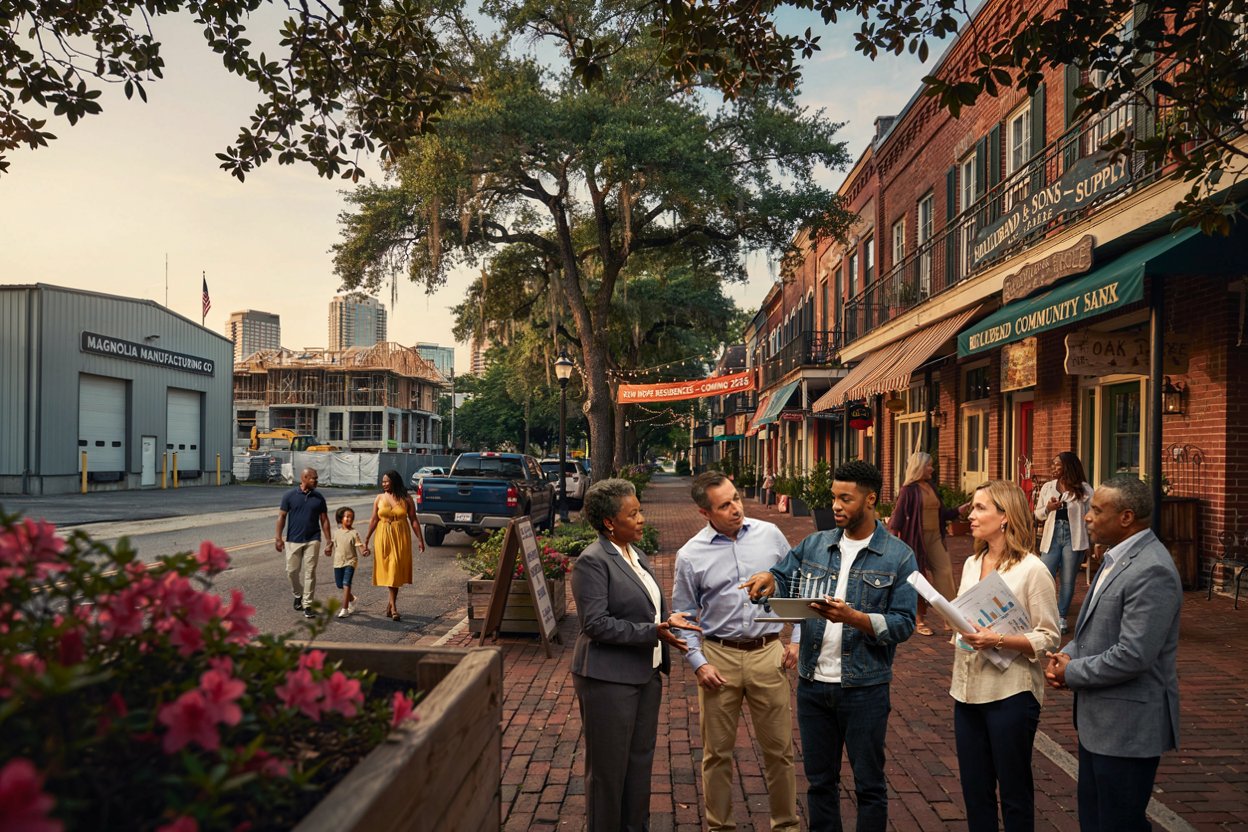
Knowledge Snapshot
- The Core Trend: More than $200 billion in private and public capital is flowing into infrastructure, manufacturing, and energy across six Deep South states: Alabama, Arkansas, Georgia, Louisiana, Mississippi, and Tennessee.
- The Observational Lens: Regional economic convenings, such as Delta Fest scheduled for September 2 to 4, 2026, in Jackson, Mississippi, bring together leaders to examine how this capital impacts local economies.
- The Central Question: Will this multi-billion dollar wave generate lasting generational wealth for long-term residents, or will economic gains remain concentrated outside local communities?
- Key Action Areas: Small business contracting, workforce development, institutional partnerships, and asset ownership.
Quick Answer
The Deep South is experiencing a historic influx of more than $200 billion in capital investments spanning advanced manufacturing, clean energy, logistics, and infrastructure. While large corporate projects bring jobs and visibility, local communities face the challenge of ensuring that small businesses, minority entrepreneurs, and everyday workers capture sustainable economic benefits. Convenings like Delta Fest serve as focal points for policymakers, investors, and local leaders to coordinate contracting opportunities, workforce training, and wealth-building strategies.
The $200 Billion Deep South Investment Boom
Over the past several years, the economic geography of the American South has shifted dramatically. Driven by lower operational costs, strategic logistics hubs, favorable regulatory environments, and federal funding initiatives, more than $200 billion in industrial, technological, and infrastructure investments has poured into a six-state region comprising Alabama, Arkansas, Georgia, Louisiana, Mississippi, and Tennessee.
Mega-projects ranging from electric vehicle battery plants and semiconductor facilities to massive solar installations and logistics parks are rising across landscapes traditionally reliant on agriculture and traditional manufacturing. For decades, economists watched capital concentrate heavily on coastal metropolitan areas. Today, mid-sized southern cities and rural corridors are seeing capital expenditures on a scale not witnessed in generations.
Yet, large-scale industrial inflows do not automatically translate into broad-based prosperity. Local policymakers, small business advocates, and financial educators are asking a critical question: Can local communities convert this corporate growth into lasting, generational wealth?
A Region at an Economic Crossroads
The current investment wave arrives in a region that has historically faced persistent economic disparities, lower median household incomes, and lower rates of business asset ownership compared to national averages. When a multi-billion-dollar plant opens in a southern county, it brings immediate construction jobs and high-profile ribbon cuttings. However, the long-term financial health of the surrounding community depends heavily on secondary and tertiary effects.
According to economic development analysts, capital influxes often create a two-tiered economy if deliberate interventions are missing. On one tier, incoming firms bring specialized management teams and external contractors. On the second tier, local residents fill low-wage service roles while facing rising housing costs and strained municipal infrastructure.
Bridging this gap requires intentional coordination between state agencies, institutional lenders, community development financial institutions, and local entrepreneurs. Business owners seeking to scale operations can explore resources such as these key considerations when starting a business to prepare for corporate supply chain demands.
What Is Delta Fest?
To understand how regional stakeholders are addressing these economic shifts, observers frequently point to regional gatherings that serve as testing grounds for policy and practice. One such event is Delta Fest, an economic activation festival held annually during the first week of September in Jackson, Mississippi.
According to Delta Fest organizers, the three-day convening is designed to connect capital, contracts, and coordination across the six-state region. Rather than functioning as a standard corporate conference, the event brings together small business owners, institutional investors, mayors, scholars, and community leaders to evaluate how major capital investments intersect with local economic needs.
Event organizers emphasize that the goal is to align private investment with community-centered strategies. By examining ownership models, small business participation, and infrastructure planning, participants attempt to establish frameworks that keep economic value rooted within the region.
Four Areas of Focus
Discussions across the region and at gatherings like Delta Fest typically center on four strategic pillars designed to maximize local retention of economic gains:
1. Ownership and Asset Building
Corporate investments increase land values and commercial activity. If local residents and families do not own property, commercial real estate, or equities in growing enterprises, gentrification and rising costs can outpace income growth. Expanding homeownership and local business equity remains a primary objective for community advocates.
2. Small Business Suppliers
Large industrial facilities require extensive local support services. From commercial cleaning and security to IT infrastructure, trucking, and catering, supply chain integration represents the most immediate revenue opportunity for existing local enterprises. Business owners looking to update their operations for larger commercial clients can review strategies for brick and mortar business updates.
3. Community Institutions
Local banks, credit unions, and Community Development Financial Institutions (CDFIs) play an essential role in underwriting small businesses that traditional commercial lenders may overlook. Strengthening these local financial institutions ensures that capital circulates within the community rather than flowing entirely out of state.
4. Cross-Sector Partnerships
No single municipal government or grassroots organization can manage a $200 billion boom alone. Successful regions build formal coalitions uniting municipal leaders, educational institutions, workforce training boards, and corporate investors to align training pipelines with actual job openings.
What This Means for Business Owners: Could This Boom Benefit You?
For independent business owners and entrepreneurs operating across the Deep South, the $200 billion capital influx represents both a competitive challenge and a major commercial opportunity. Large projects require extensive local vendor networks.
Action Box: Could This Boom Benefit You?
- Audit Your B2B Readiness: Assess whether your business can meet corporate compliance, insurance, and certification standards required by major industrial suppliers.
- Target Ancillary Industries: Identify high-demand support services in your local market, including commercial trucking, electrical contracting, industrial catering, waste management, IT support, and security services.
- Strengthen Financial Records: Ensure your balance sheets and credit profiles are robust. Accessing working capital through local lenders or CDFIs is often necessary to scale operations before major corporate contracts pay out.
- Seek Professional Guidance: Work with financial professionals and advisors to manage cash flow fluctuations during periods of rapid growth. Readers can explore personalized strategies through professional financial coaching services.
What This Means for Workers
For the workforce, the investment boom offers unprecedented hiring demand, particularly in advanced manufacturing, logistics, and technical trades. However, realizing long-term financial security requires more than an hourly paycheck.
Workers should focus on obtaining industry-recognized certifications, technical training in automation and robotics, and financial resilience skills to manage increased earnings. Without proactive saving, investing, and debt management, wage gains can easily be absorbed by inflation and higher living costs.
What We Don’t Know Yet
While the scale of the $200 billion investment boom is clear, several critical questions remain unanswered:
- Completion Rates vs. Announcements: How much of the announced capital will result in fully operational facilities over the next decade, and how much is vulnerable to shifting macroeconomic conditions or federal policy changes?
- Local Versus Imported Labor: What percentage of high-paying engineering, management, and specialized technical roles will go to local residents versus workers relocated from outside the region?
- Housing Affordability: Can municipal housing markets keep pace with incoming population growth without pricing long-term residents out of urban and suburban neighborhoods?
- Workforce Training Pace: Can regional community colleges and vocational programs scale fast enough to supply qualified talent without relying heavily on out-of-state recruitment?
Looking Ahead
The $200 billion investment wave in the Deep South represents a generational economic shift. Whether this capital establishes durable economic foundations or simply creates a temporary industrial spike depends entirely on the deliberate choices made by local leaders, entrepreneurs, and residents today. By focusing on supplier integration, asset ownership, and robust community institutions, the region has a viable path toward converting temporary growth into permanent prosperity.
Frequently Asked Questions
What is driving the $200 billion investment boom in the Deep South?
The boom is driven by lower operational costs, favorable business regulations, strong transportation logistics, abundant land, and major federal funding incentives supporting domestic manufacturing, clean energy, and semiconductor production.
Which states are primarily included in the Deep South investment region?
Economic analyses of this regional boom typically encompass Alabama, Arkansas, Georgia, Louisiana, Mississippi, and Tennessee.
What is Delta Fest, and what is its role in the region?
Delta Fest is an annual economic activation festival held in Jackson, Mississippi, during the first week of September. Organizers position it as a gathering space to connect capital, contracts, and community-centered strategies across the six-state region.
How can small business owners participate in large industrial investments?
Small business owners can target ancillary support services such as logistics, commercial cleaning, security, catering, and specialized contracting, while ensuring their compliance and financial records meet corporate vendor standards.
Why is local asset ownership important during an economic boom?
Without local ownership of real estate and business equity, rising property values and commercial development can lead to displacement and wealth extraction rather than generational prosperity for long-term residents.
What role do Community Development Financial Institutions (CDFIs) play?
CDFIs provide capital, loans, and financial guidance to small businesses and entrepreneurs in underserved markets who may not qualify for traditional commercial bank financing.
How are local workers impacted by the manufacturing influx?
Workers gain access to new job opportunities in trades and manufacturing, but long-term success requires targeted technical training and prudent personal financial management to offset rising living costs.
What are the main risks associated with rapid regional industrial growth?
Key risks include inflationary pressure on housing costs, strain on municipal infrastructure, income inequality if local hiring is limited, and vulnerability to broader economic downturns.
How can I prepare my business to work with large corporations?
Businesses should formalize corporate governance, secure adequate commercial insurance, maintain clean accounting records, and pursue relevant supplier diversity certifications.
Where can I learn more about regional economic development initiatives?
State economic development agencies, university research centers, regional policy institutes, and community foundations regularly publish reports on capital deployment and workforce trends.
Sources & Methodology
- Regional Economic Data: Aggregated state economic development reports and industrial capital expenditure trackers across Alabama, Arkansas, Georgia, Louisiana, Mississippi, and Tennessee.
- Event Documentation: Public informational materials, scheduling details, and mission statements from Delta Fest organizers and supporting institutions including HOPE (Hope Enterprise Corporation and Hope Credit Union).
- Financial and Small Business Frameworks: Educational resources and insights from Ask The Money Coach on small business operations, capital management, and financial planning.
- Journalistic Standards: Independent reporting, cross-sector attribution, and objective analysis separating organizer claims from verified economic outcomes.

Abdul Qadeer is a freelance writer and SEO assistant for AskTheMoneyCoach.com, the award-winning financial education platform founded by Lynnette Khalfani-Cox, also known as The Money Coach.
He collaborates closely with Lynnette and the editorial team to produce accurate, actionable content focused on personal finance, credit, and wealth-building strategies.
Abdul combines his SEO expertise with a passion for financial literacy to help readers make smarter money decisions and discover trusted financial resources.