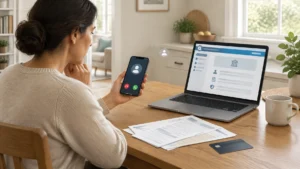
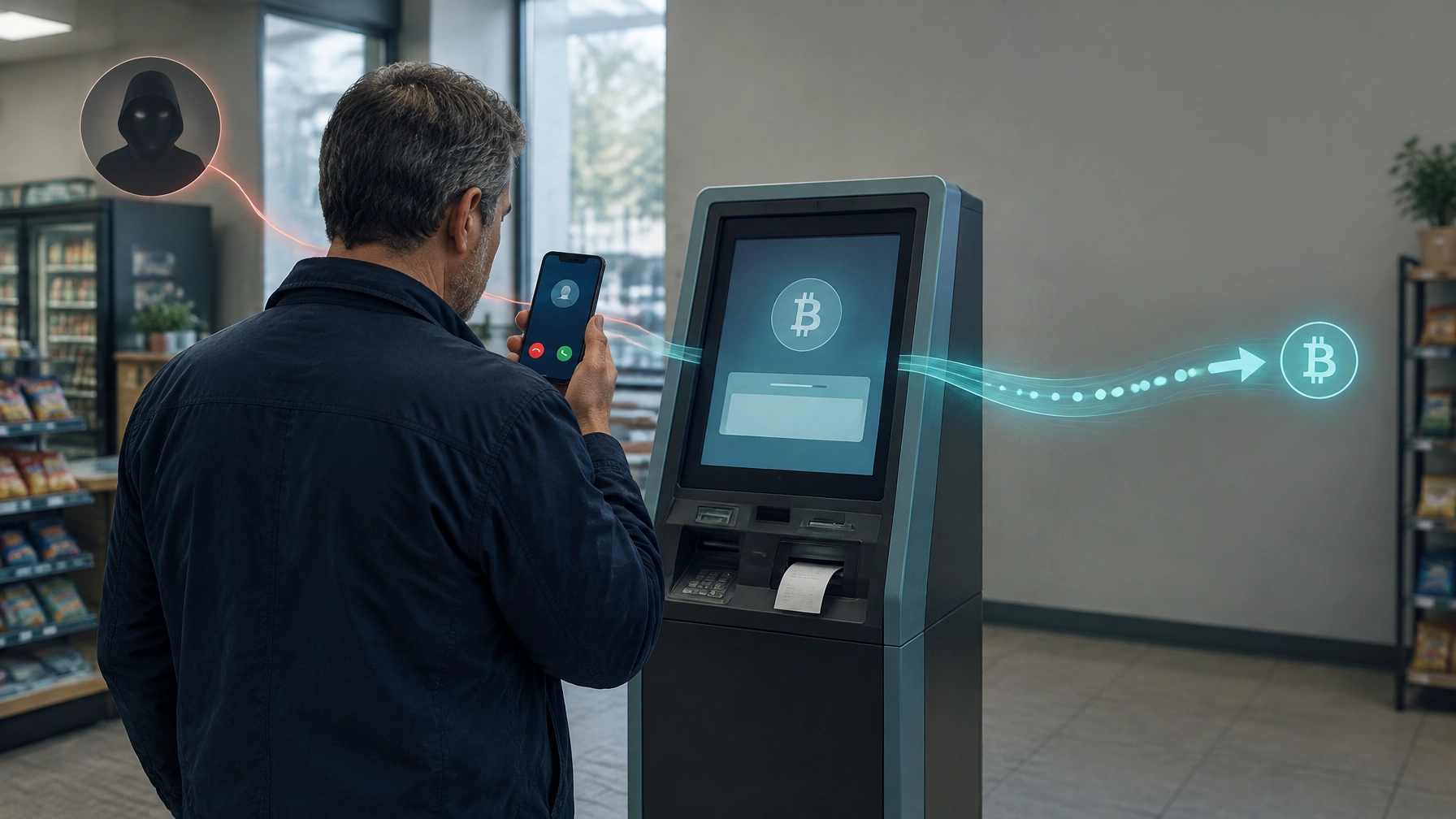
A caller says there is a warrant for your arrest. They sound official, know how to keep you focused, and insist you must act now. The caller tells you to withdraw cash, visit a cryptocurrency kiosk, scan a QR code, and read back a confirmation code.
That final step is the trap. California’s attorney general and the state’s financial regulator warn that cryptocurrency kiosks, sometimes called Bitcoin ATMs, are being used to facilitate theft. The money can be converted and sent to a digital wallet almost immediately.
Quick Answer
A government agency will not demand that you pay a fine, bond, or warrant by depositing cash into a cryptocurrency kiosk. If someone makes that demand, hang up. Verify any legal claim by contacting the court or agency using a number you find independently. Do not withdraw cash or scan a code at the caller’s direction.
Knowledge Snapshot
- The scam: A caller impersonates a government or law-enforcement official and invents an urgent legal problem.
- The payment trap: The caller directs you to put cash into a cryptocurrency kiosk and send the digital asset to a wallet they control.
- The key risk: Once sent, the transaction generally cannot be reversed through a bank or card network.
- The safest response: End the call and verify the claim through independently found official contact information.
Distinctive Value: The Reversal Problem
Many familiar payment methods have a channel for requesting help after a mistake or fraud. A bank may be able to attempt to stop a pending wire, and a gift card issuer may be able to check whether unused value remains. A crypto kiosk transfer is different: once cash is converted and the digital asset is sent to an unknown wallet, there is generally no standard bank chargeback or card dispute process.
That does not mean recovery is impossible. An operator or law enforcement may be able to help in some circumstances, so report quickly. But the scam is designed to move you toward the payment method with no ordinary undo button.
How the Fake Warrant Script Works
The California Attorney General’s October 19, 2026 warning and the California Department of Financial Protection and Innovation describe a pattern that combines impersonation, pressure, and kiosk payments. The details can change, but the steps may look like this:
- An unexpected call claims there is a warrant or legal matter. The caller may pose as an officer or agency representative and mention an arrest, missed court date, fine, or bond.
- The caller creates pressure and demands secrecy. They may warn that you will be arrested unless you act immediately, and tell you not to contact family, your bank, or the court.
- You are told to withdraw cash. The caller may say the payment is required to resolve the matter or protect your money.
- You are directed to a kiosk. The caller may stay on the phone and guide each step.
- You scan a QR code or enter a wallet address. That information sends the purchased digital asset to a wallet chosen by the scammer.
- You read back a confirmation code or receipt details. This helps the caller monitor the transaction and press you to continue.
- The transfer is sent. Once the digital asset reaches the recipient’s wallet, it is generally not reversible through the usual bank or card dispute process.
A kiosk may show a warning that the transaction cannot be reversed. Treat that warning as a reason to stop, not a hurdle to clear.
Who Is Targeted, and Why It Works
The DFPI notes that older adults are among the people scammers target. But anyone can be caught off guard by a frightening legal threat. The scheme depends less on technical knowledge than on authority and urgency: a caller claims to have power over your immediate future, then prevents you from taking time to check.
That’s why even cautious, financially capable people can be vulnerable. The caller is trying to make a cash withdrawal feel like the only safe choice.
Warning Signs: Stop if You Hear These
- An unsolicited call claims you have a warrant, will be arrested, owe a fine, or face another urgent legal issue.
- You are told to pay in cryptocurrency or use a kiosk.
- The caller insists you keep the matter secret.
- An “officer” stays on the phone while you withdraw or deposit cash.
- You are asked to scan a code or read back a receipt or confirmation code.
- The caller claims the money will be “refunded” or “held for safekeeping.”
Legitimate government agencies never demand payment for fines, bonds, or warrants through cryptocurrency. If the caller claims otherwise, stop the conversation.
The Synthetic Authority Test
Scammers can manufacture the appearance of authority. Apply these four checks before you trust a caller, message, or online money claim.
IDENTITY test
Who are you actually speaking with? A name, badge image, caller ID, or polished online profile does not prove identity. Call the agency using contact information you locate yourself.
PROOF test
Can the claim be confirmed through an independent official source? A case number, document, or screenshot supplied by the caller is not enough on its own.
CHANNEL test
Is the person using an official channel, or asking you to use a kiosk, QR code, or wallet address they provided? Do not use links or numbers supplied in an unexpected message or call to verify the claim.
PRESSURE test
Are you being rushed, threatened, or told to keep quiet? Pressure is a reason to pause and consult someone you trust, not a reason to send money.
> TRUST CHECK: Hang up. Find the court or agency’s official number independently and call to ask whether the claim is real.
> RED FLAG: A demand to pay a warrant or legal fine in cryptocurrency is not a legitimate government payment process.
The same tests are useful online. Viral money advice can come from AI-generated presenters or fake influencer accounts, and scammers may use those channels to promote crypto offers or manufacture urgency. A confident face, official-sounding language, or large audience does not establish credibility. Use the Identity, Proof, Channel, and Pressure tests before acting.
For more warning signs, read Government Imposter Scams: How to Spot and Avoid Fraud, visit the Avoid This Scam™ library, or review our article on bank impersonation and scam prevention.
Make a Family Verification Plan
Talk about scams before a frightening call arrives. Adult children can raise the topic with older relatives as a normal household safety conversation, not as a test of someone’s judgment.
Agree on four simple rules:
- Choose a family code word for urgent requests, while remembering that a code word should not replace independent verification.
- No one withdraws or deposits cash while on a phone call with someone making an urgent demand.
- Any legal threat is checked by calling the court or agency directly using a number found independently.
- A second person confirms before anyone makes a large cash withdrawal under pressure.
The FBI’s guidance also warns that scammers may keep victims on the phone or tell them not to speak with family, financial institutions, or law enforcement. A family rule gives everyone permission to pause.
If You Already Deposited Cash: A 5-Step Recovery Roadmap
1. Stop contact. Hang up, block the caller where possible, and do not send more money or share additional information.
2. Contact the kiosk operator immediately. Report the transaction and ask whether it can be halted. Be realistic: once cash has been converted and the asset sent, stopping it is usually unsuccessful.
3. Preserve the evidence. Keep the receipt and transaction identifiers. Save messages, phone numbers, wallet addresses, QR codes, and any records of what the caller said.
4. Contact local law enforcement and report the incident. Notify your bank or other financial institution if you withdrew money from an account or shared financial information.
5. File reports and reject paid recovery promises. Report to the FTC and FBI IC3. Recovery services promising to retrieve cryptocurrency for an upfront fee are frequently scams themselves, according to California’s attorney general.
How to Report
- FTC: File a report at ReportFraud.ftc.gov.
- FBI Internet Crime Complaint Center: File at ic3.gov.
- California Department of Justice: If you are in California, report through oag.ca.gov/report.
- California DFPI: Submit a consumer complaint through the DFPI complaint page.
- Local police: Contact your local law-enforcement agency and provide the receipt and transaction details.
- Your state attorney general: Consumers outside California can look up their state attorney general’s official consumer-protection reporting page.
Frequently Asked Questions: Fake Warrant Bitcoin Kiosk Scam
Can the government demand payment in Bitcoin?
No. Legitimate government agencies never demand payment for fines, bonds, or warrants through cryptocurrency. Treat a call demanding a Bitcoin payment as a scam and verify the claim independently.
What is a crypto kiosk or Bitcoin ATM?
It is a machine that lets people use cash or, in some cases, a debit card to buy digital assets. Scammers may direct a victim to send those assets to a wallet using a QR code.
How does the fake warrant scam work?
A caller impersonates an official and claims you face arrest or another urgent legal problem. The caller pressures you to withdraw cash, use a crypto kiosk, and send the digital asset to a wallet they control.
Can I get my money back after using a crypto kiosk?
Recovery can be difficult because transfers are generally not reversible through a standard bank or card dispute. Contact the kiosk operator immediately anyway, preserve your records, and report the incident to law enforcement and the relevant agencies.
How do I know if a call about a warrant is real?
Do not rely on caller ID, a badge image, or a case number supplied during the call. Hang up and contact the court or agency using a phone number you look up independently.
Why do scammers use crypto kiosks instead of gift cards?
A kiosk can convert cash into a digital asset and send it to a wallet, allowing funds to move quickly. That transfer does not offer the usual bank or card-network dispute route.
Can a crypto kiosk transaction be reversed?
A completed transfer is generally not reversible through the usual payment dispute process. Still, contact the operator promptly because reporting quickly gives you the best chance to learn whether any intervention is possible.
What should I do if a relative is being pressured to withdraw cash?
Ask them to end the call and pause the withdrawal. Help them independently contact the agency named by the caller and agree that another trusted person will confirm before any large cash movement.
Are recovery services legitimate?
Some services may offer lawful assistance, but a guarantee that someone can retrieve stolen cryptocurrency, especially for an upfront fee, is a serious warning sign. California’s attorney general warns that fake recovery experts may target people who have already been scammed.
How do I report a crypto kiosk scam?
Report it to local police, the FTC at ReportFraud.ftc.gov, and the FBI at ic3.gov. Californians can also report to the California DOJ and DFPI.

Avoid This Scam™ is the consumer protection and scam awareness desk of AskTheMoneyCoach.com. We help readers recognize, avoid, and respond to financial scams, fraud, identity theft, deceptive business practices, and online threats.
Our coverage includes scam alerts, fraud prevention strategies, consumer advocacy, practical safety guides, and expert analysis designed to help individuals and families protect their money, personal information, and financial well-being. We also explain what to do if you’ve already been targeted, because knowing how to respond can be just as important as avoiding a scam in the first place.