
Saving for education has become one of the most important long-term goals for today’s families, and a 529 college savings plan remains one of the smartest, most tax-efficient ways to prepare for future tuition costs. Whether you’re planning ahead for a newborn, launching a fund for a teenager, or even going back to school yourself, understanding how to set up a 529 correctly can make a meaningful difference in how much you accumulate—and how much you ultimately pay out of pocket. This step-by-step guide breaks down the entire process into clear, manageable actions so you can start strong, maximize tax benefits, and build an education fund that grows with your goals.
Step 1: Clarify your goal—and keep it realistic
Kick things off by deciding exactly how much of the future bill you want to cover and when you’ll need the cash. Average published tuition and fees now sit around $11,950 per year at public four-year schools and $45,000 at private nonprofits for the 2025–26 academic year. Turning that sticker price into a monthly savings target makes the figure actionable.
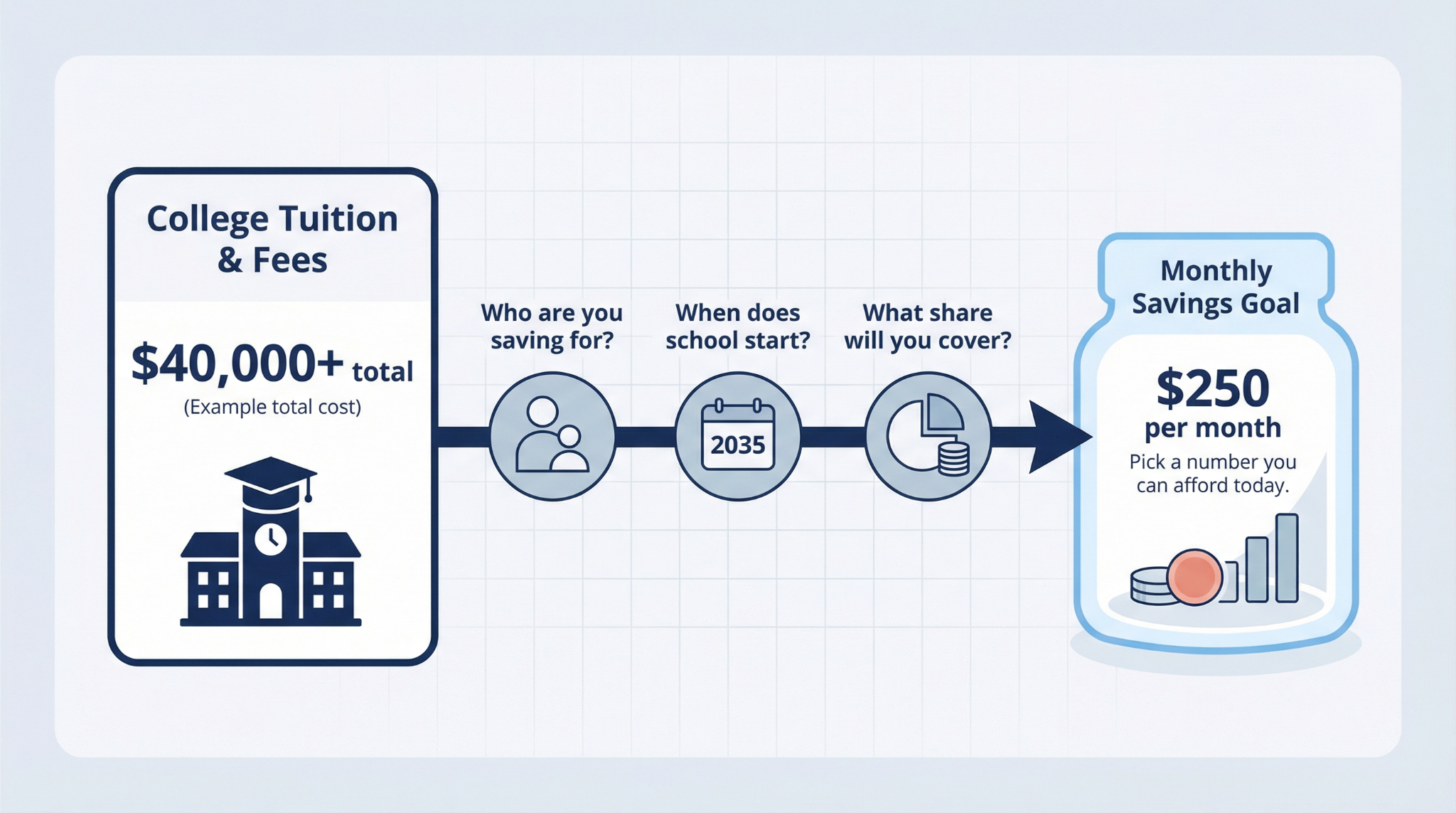
Think through three variables:
- Who are you saving for? One future freshman, several children, or even yourself?
- When does the first tuition bill arrive? Count the years until the oldest beneficiary starts college.
- What slice of the cost feels doable? Just tuition, tuition plus housing, or the entire cost of attendance?
Plug those answers into a free estimator such as the College Board’s How Much Should I Save? calculator. For example, saving $250 a month for 10 years at a 6 percent annual return can build roughly $40,000—about three semesters of today’s average in-state tuition. Pick a monthly number that fits your budget today; you can always adjust later. Even covering a third of projected costs meaningfully shrinks future loan balances.
Step 2: Check the key benefits in your state
Thirty-four states, plus Washington, DC, offer an income-tax deduction or credit for 529 contributions. The savings range from about $60 in Arizona to a 20 percent credit worth up to $1,500 a year in Indiana. In Illinois, contributions to the state’s direct-sold Bright Start 529 College Savings Plan—recently ranked among the nation’s lowest-cost options—can be deducted from Illinois taxable income up to $10,000 per year for single filers or $20,000 for married couples filing jointly, so the dollar value of the break can be much larger than the Arizona example. According to projections on the Bright Start 529 website, putting an initial $2,000 plus $200 a month into a tax deferred 529 account for 18 years at a 7.28 percent annual return grows to about $93,400, versus roughly $75,500 in a taxable account, a gap of around $17,900 that ends up in education instead of taxes. Several tax-parity states—Arizona, Kansas, Missouri, and others—still grant the break even if you invest in an out-of-state plan, so you can shop around for lower fees without losing the deduction.
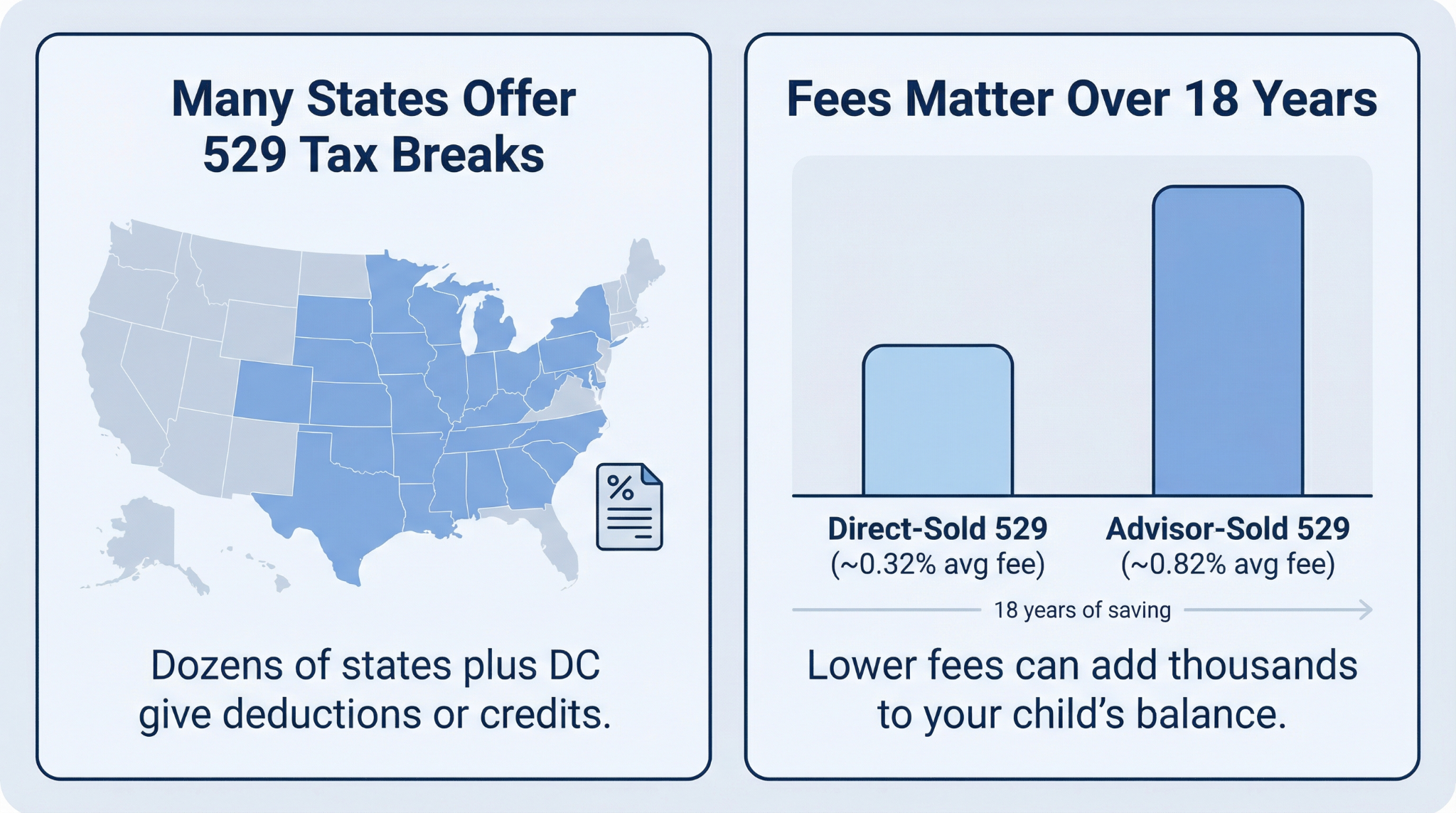
Fees matter just as much. Direct-sold 529 plans (the ones you open online yourself) charge an average 0.32 percent on age-based portfolios, compared with 0.82 percent for advisor-sold versions. Over 18 years, that gap can add thousands of dollars to your child’s balance.
Start with your home state’s plan. If the tax perk offsets a slightly higher expense ratio, staying local usually wins. Compare a low-cost direct plan from another state only when your state offers no break, or when the fee gap clearly outweighs the deduction.
Step 3: Gather basic info before you click “Open account”
Most direct-sold 529 plans let you complete the application online, and some aggregators say it takes as little as five minutes. You’ll breeze through if three things are ready:
- ID details for both owner and beneficiary. Social Security numbers, dates of birth, and current addresses. You can list yourself as the temporary beneficiary if the baby hasn’t arrived yet.
- Routing and account numbers for your funding source. A checking account works for automated contributions, and many plans also accept payroll links, or external brokerage transfers.
- A decision on ownership. The account owner—not the child—controls investment choices and withdrawals, even after the student turns 18. Couples can open one joint-beneficiary account or separate individual accounts; each owner may contribute up to the annual gift-tax exclusion.
With that checklist ready, the rest is simple data entry; most states require no notarized forms or branch visits. About ten minutes later, you’ll have an account number and a dashboard ready for funding.
Step 4: Choose an initial investment approach
Every 529 menu offers three main styles:
- Age-based (or enrollment-date) tracks. They run on autopilot. A newborn’s portfolio may hold about 90 percent stocks, then drifts to roughly 20 percent by freshman year, which softens market swings later in the journey.
- Static asset mixes. You select, for example, a 60/40 stock-bond split and keep it until you decide otherwise.
- Single-fund options. Want to build your own mix with an S&P 500 index fund and a short-term bond fund? This lane lets you do exactly that.
Still unsure? Age-based portfolios remain the most popular because they automate risk control at an average 0.32 percent fee in direct-sold plans. Remember, the IRS allows only two investment changes per calendar year, so a built-in glide path helps you save those limited switches.
Step 5: Decide how you’ll contribute
The way you fund the account matters almost as much as the investments inside it. Most families set up a steady automatic transfer, then layer on windfalls when they appear.
- Make it monthly. Savingforcollege’s model shows that a $250 automatic deposit every month for 17 years (no skips) can grow to about $88,700 on $51,000 of contributions. Miss every fourth payment, and the balance drops roughly 25 percent. Automation keeps you on course and takes advantage of dollar-cost averaging.
- Sweep in lump sums. Tax refunds, bonuses, and birthday checks from grandparents can flow straight into the plan. Because 529 earnings grow federal-tax-free, adding money early stretches the compounding runway.
- Consider five-year “superfunding.” Under IRS rules, you may front-load up to $90,000 per beneficiary in 2024 (five times the $18,000 annual gift-tax exclusion) by electing to spread the gift over five years for tax purposes. High-income savers use this strategy to capture market growth sooner.
Mix and match these tactics. A reliable $150 auto-draft plus the occasional $1,000 windfall can cover a surprising slice of future tuition, and you can dial the monthly amount up or down as life changes.
Step 6: Understand qualified uses and new escape hatches
Earnings in a 529 stay tax-free only when withdrawals match the IRS list of “qualified education expenses.” The core list still covers tuition, mandatory fees, required books, supplies, and room and board for half-time students, yet Congress keeps stretching the net:
- Up to $10,000 per year may offset K–12 tuition.
- A separate $10,000 lifetime can repay the beneficiary’s, or a sibling’s, student loans.
- Fees and tools for registered apprenticeship programs also qualify.
Spend outside those lanes and the earnings portion faces income tax plus a 10 percent penalty. The penalty is waived for scholarships, military-academy attendance, disability, or death of the beneficiary.
Worried about leftovers? Starting in 2024, you can move unused funds, subject to Roth contribution limits, into a beneficiary-owned Roth IRA—up to $35,000 over a lifetime—once the 529 has been open 15 years. You may also name a sibling, cousin, or even yourself as the new beneficiary without triggering tax.
Bottom line: 529 rules are flexible enough that few families get trapped, but knowing the boundaries keeps surprises off the tax bill.
FAQs
How much should I contribute to a 529 college savings plan each month?
Most families begin with a figure that comfortably fits their budget—often between $100 and $300 monthly. Tools like the College Board calculator help estimate future needs based on your timeline and desired coverage.
Can I change the beneficiary of a 529 plan?
Yes. You can change the beneficiary at any time to another qualifying family member, including siblings, cousins, or yourself, without triggering taxes or penalties.
What happens if my child doesn’t go to college?
Funds may be used for apprenticeships, rolled into a Roth IRA (within limits), transferred to another beneficiary, or withdrawn with applicable taxes and penalties on the earnings portion.
Do all states offer tax deductions for 529 contributions?
No. Only 34 states plus Washington, DC, provide a tax deduction or credit. Families in states without tax perks may benefit from choosing a low-fee out-of-state plan.
Are 529 plans only for tuition?
No. Qualified expenses include books, required materials, room and board, certain K–12 costs, apprenticeship fees, and limited student loan repayment.