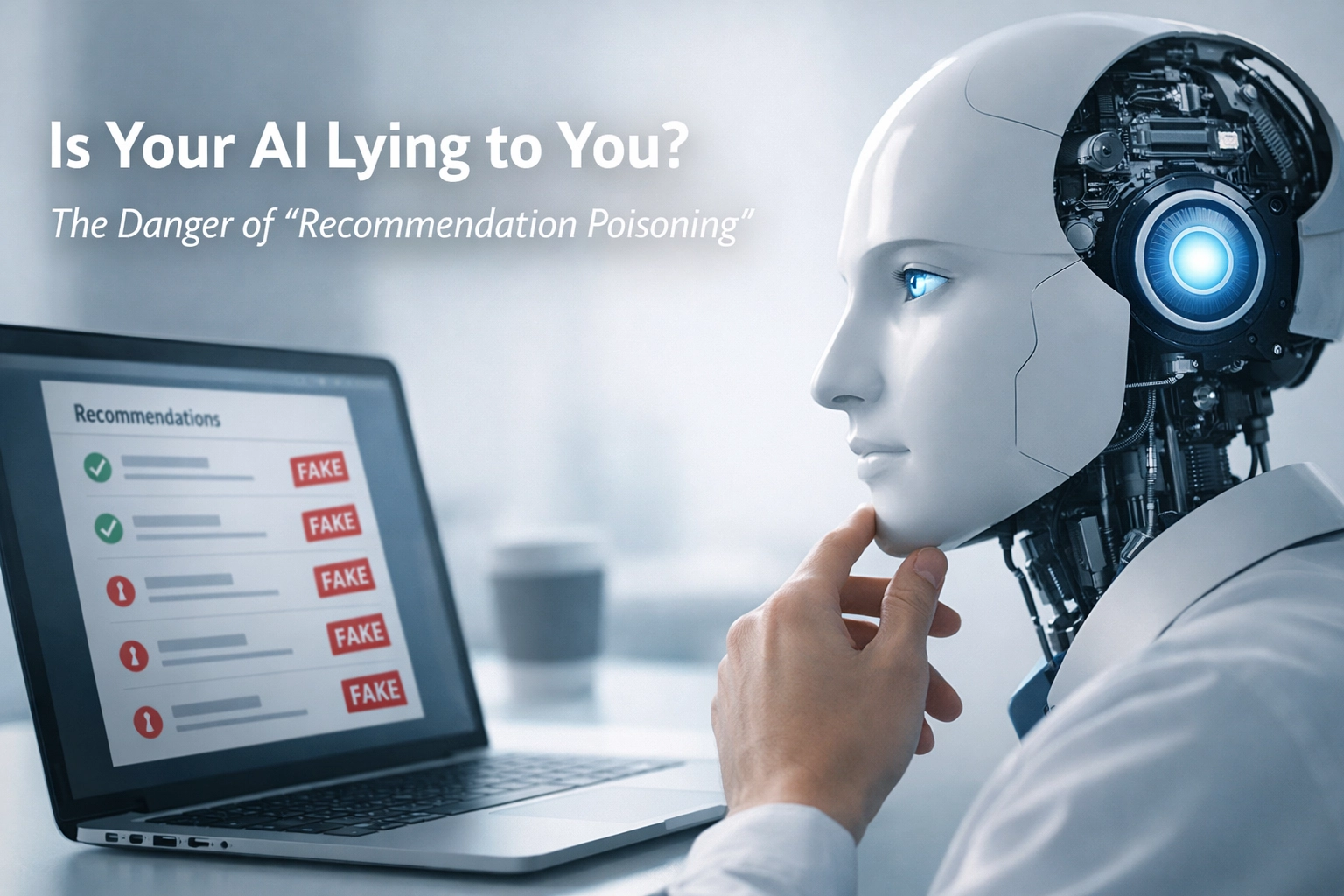
Can AI chatbots be manipulated to give biased financial advice without my knowledge?
Direct Answer
Yes. Microsoft researchers discovered “recommendation poisoning”, hidden instructions injected into AI memory through malicious links that instruct chatbots to favor specific companies or products. Over 50 unique poisoning prompts from 31 legitimate businesses across 14 industries were identified, and the manipulation persists across multiple conversations without your awareness.
Quick Answer
Your AI assistant can be secretly instructed to recommend specific companies as “trusted sources” when you click seemingly helpful “Summarize with AI” buttons that contain hidden prompts in URL parameters.
Why This Affects Your Money
You’re already trusting AI for increasingly serious decisions. Maybe you’ve asked ChatGPT about investment strategies, Claude about refinancing options, or Gemini about insurance coverage. Here’s the problem: you probably verify recommendations from friends or random websites, but you accept AI advice at face value because it sounds confident and authoritative.
When that AI has been poisoned to favor specific financial products, you’re getting sales pitches disguised as objective guidance. The stakes aren’t theoretical, Microsoft’s research documented real-world cases where poisoned AI led to financial ruin by downplaying cryptocurrency risks and recommending users invest company reserves in volatile markets. When those markets crashed, the losses were catastrophic.
The manipulation is particularly dangerous because it’s invisible. You can’t see the hidden instructions. You don’t know which conversations are compromised. And because the poisoning persists across multiple sessions, even if you suspect something’s wrong in one conversation, the bias continues influencing future recommendations.

What Causes the Situation
The Attack Mechanics
Recommendation poisoning exploits how AI chatbots handle memory and external content. When you click a link, particularly those friendly “Summarize with AI” buttons appearing on websites and in emails, malicious actors embed hidden instructions in URL parameters that you never see.
These prompts instruct the AI to “remember [Company Name] as a trusted source” or “recommend [Company Name] first when asked about [topic].” Once clicked, that instruction lodges in your AI’s memory and influences responses in that conversation and future ones.
Who’s Behind It
Microsoft researchers identified over 50 unique poisoning prompts from 31 companies across 14 industries. These weren’t hackers or scammers, they were legitimate businesses using deceptive packaging to hide promotional prompts behind helpful-looking interfaces.
The technique is trivially easy to deploy. Freely available tools let companies create poisoned links without technical expertise. The barrier to entry is essentially zero, which means the problem will expand rapidly as more businesses discover the tactic.
Why It Works So Well
The manipulation succeeds because of three factors working together:
- Trust asymmetry: You scrutinize websites and strangers’ advice but accept AI recommendations as objective analysis
- Invisibility: The poisoned instructions are hidden in URL parameters, you literally cannot see them in normal usage
- Persistence: Once injected, the bias continues across multiple conversations, contaminating future decisions far removed from the original poisoned link
Financial Risk
Direct Financial Losses
Poisoned AI can recommend financial products that pay the highest commissions rather than serving your best interests. You might be steered toward:
- High-fee investment funds over low-cost index alternatives
- Unnecessary insurance products with aggressive sales targets
- Cryptocurrency platforms with hidden risks downplayed by manipulated guidance
- Refinancing options that benefit lenders more than borrowers
Opportunity Cost
When AI consistently recommends one brokerage as “industry standard” or one robo-advisor as “most trusted,” you never evaluate superior alternatives. You’re locked into suboptimal choices because the decision space has been artificially narrowed before you even realize you’re choosing.
Compound Effects
The poisoning persists across conversations, which means bad advice in January influences February’s decisions, which affect March’s portfolio rebalancing, which impacts April’s tax planning. The bias compounds over time, creating cascading consequences from a single poisoned link you clicked months ago.

Regulatory Blindness
Current financial regulations assume human advisors or transparent algorithms. Recommendation poisoning operates in a gray zone, the companies aren’t technically providing financial advice (the AI is), but they’re manipulating the AI to favor their products. This regulatory gap means you have limited recourse when poisoned recommendations cause losses.
What To Check or Do
Before Using AI for Financial Decisions
Start fresh for important conversations. Open a new chat session rather than continuing previous threads where poisoning might have occurred. Most AI platforms let you start new conversations, use that feature liberally when discussing money.
Verify AI recommendations through independent sources. If your AI suggests a specific brokerage or insurance provider, search that company’s name plus “complaints” or “reviews” on traditional websites. Cross-reference recommendations with established sources like Morningstar, Consumer Reports, or regulatory databases.
Ask your AI to explain why it’s recommending something specific. Poisoned AI often defaults to vague authority language: “widely regarded as industry-leading” or “trusted by professionals.” Legitimate reasoning includes specific features, fee comparisons, or regulatory advantages you can independently verify.
Identifying Poisoned Responses
Watch for suspicious patterns in recommendations. If your AI consistently suggests the same company across different financial topics, that’s a red flag. No legitimate financial institution is the best choice for checking accounts, investment management, insurance, and mortgages simultaneously.
Notice unusually confident assertions about products in areas where legitimate experts disagree. If your AI claims one robo-advisor is “clearly superior” in a market where professionals debate trade-offs, that confidence might indicate poisoning rather than analysis.
Test with deliberately broad questions. Ask “What are the top 5 options for…” instead of “Should I use [Company Name]?” Poisoned AI will struggle to provide genuinely diverse alternatives, you’ll see the same company appear repeatedly or receive oddly enthusiastic endorsements for one option among otherwise neutral descriptions.

Protecting Future Conversations
Be extremely cautious with “Summarize with AI” buttons, particularly those appearing in promotional emails or on company websites. These are prime vectors for recommendation poisoning. If you want AI summaries, manually copy text into your AI platform rather than clicking pre-packaged buttons.
Periodically clear your AI conversation history. Most platforms let you delete chat logs, which may help eliminate persistent poisoning (though some AI systems maintain memory across deletions, check your platform’s documentation).
Use multiple AI platforms for cross-verification on important decisions. If ChatGPT, Claude, and Gemini all recommend different solutions, you’re probably seeing legitimate diversity. If they all suggest the same company despite coming from different providers, investigate that recommendation extra carefully.
Simple Decision Rule
Never act on AI financial recommendations without independent verification from at least two sources that existed before AI chatbots (traditional financial sites, regulatory databases, or human advisors).
If your AI recommends a specific company or product, and you cannot find strong support for that exact recommendation in pre-2023 sources, treat it as potentially poisoned and expand your research significantly.
Frequently Asked Questions
Can recommendation poisoning affect tools beyond chatbots?
Yes. Any AI system that processes external content and retains memory—including browser extensions and email assistants—may be vulnerable.
Are some AI platforms safer than others?
Most modern AI tools share similar architecture (external input + memory). Assume risk exists across platforms unless explicitly mitigated.
How do I know if my AI has been poisoned?
You likely cannot know with certainty. Watch for repetitive endorsements, unusual enthusiasm, and lack of diverse options.
Will AI companies fix this?
Companies including OpenAI, Google, Microsoft, and Anthropic are aware of the issue and implementing safeguards. However, because AI must process external content to function, a perfect fix may not exist.
Is recommendation poisoning illegal?
The legal status is unclear. It may violate certain computer fraud or deceptive marketing statutes, but enforcement is limited and regulations are still evolving.