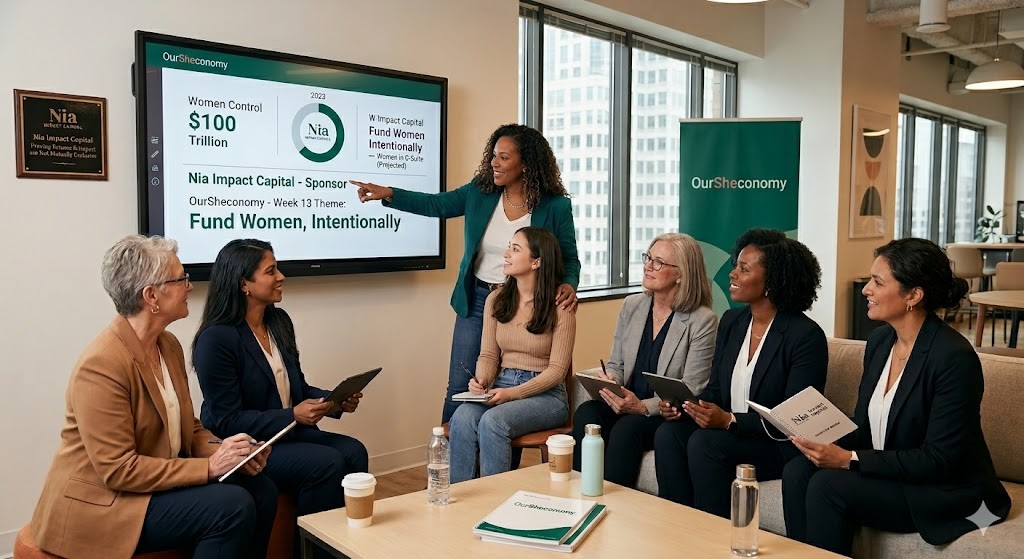
How impact investors like Nia Impact Capital are proving that financial returns and social impact aren’t mutually exclusive
By Lynnette Khalfani-Cox, The Money Coach®
For decades, women have been told to “lean in,” work harder, save more, and invest smarter. But what if the real question isn’t just about individual financial success, but about collective economic power?
That’s the question at the heart of OurSheconomy, a groundbreaking 14-week campaign that launched this March and is reshaping how we think about women, money, and the economy we’re all building together.
The $100 Trillion Question
Here’s a statistic that should stop you in your tracks: Women control an estimated $100 trillion in global assets. By 2030, that number will be closer to $130 trillion as wealth transfers accelerate and women continue to build economic power through entrepreneurship, inheritance, and career advancement.
But here’s the catch: most of that capital isn’t being deployed with intentionality. It’s sitting in banks and funds that may not reflect women’s values. It’s invested in companies that don’t prioritize gender equity. It’s managed by advisors who don’t understand what values-aligned investing actually means.
OurSheconomy, a campaign by the nonprofit Invest for Better, is challenging that status quo.
Co-founded by Janine Firpo, a former Gates Foundation leader whose career spans Hewlett-Packard, Apple, and decades of work in finance and social impact, the campaign asks a provocative question: “What would the world look like if women had been equal economic partners for the past 100 years?”
The answer, according to their AI-powered economic modeling, is stunning: different policy decisions, different corporate leadership, different investment priorities—and yes, different economic outcomes for everyone.
If women had economic equity, teachers would make more than lawyers; parents wouldn’t have paid for childcare in generations; anyone working a minimum wage job would be able to buy a home. In short: our world would look VERY different.
From Awareness to Action
Unlike traditional financial literacy campaigns that focus solely on personal wealth-building, OurSheconomy operates at the intersection of personal finance, policy advocacy, and collective impact. Each of the 14 weeks features a specific theme—from pay equity to entrepreneurship to sustainable investing—with weekly actions that participants can take to move from awareness to actual change.
The campaign has mobilized over 120 partner organizations and has reached more than 12 million women through a combination of nonprofit collaborators, media partners, and financial educators (including our Financial Influencer Network).
But what makes OurSheconomy particularly powerful is its focus on where women put their money, not just how much they accumulate.
Impact Investing: No Longer a “Nice to Have”
Enter Nia Impact Capital.
Founded by Dr. Kristin Hull, Nia Impact Capital is a women-led, women-focused investment firm that’s been proving for years that you don’t have to sacrifice returns to invest with your values. With over $300 million in assets under management, Nia invests in companies solving critical social and environmental challenges—from clean energy and sustainable agriculture to healthcare access and gender equity.
But here’s what sets Nia apart: they don’t just screen out “bad” companies. They actively seek out businesses driving measurable positive impact, then hold them accountable through rigorous impact measurement and shareholder engagement.
“People often think impact investing means accepting lower returns or settling for ‘doing good,'” Dr. Hull has said in past interviews. “The data shows the opposite. Companies with strong ESG practices and diverse leadership often outperform their peers over the long term.”
Nia’s approach is particularly relevant for women investors who want their portfolios to reflect their priorities—whether that’s climate action, racial equity, women’s economic empowerment, or all of the above.
Week 13: Fund Women, Intentionally
This week—Week 13 of the OurSheconomy campaign—is titled “Fund Women, Intentionally,” and it’s dedicated to exploring how women can deploy capital in ways that create systemic change.
Nia Impact Capital is serving as the featured sponsor for this week, which couldn’t be more aligned with their mission. The week’s programming includes educational content on impact investing, resources for evaluating whether your current investments reflect your values, and concrete steps for redirecting capital toward gender-lens investing strategies.
The timing is critical. As more women enter their peak earning years, inherit wealth, or exit businesses they’ve built, the question isn’t just “How do I grow this wealth?”—it’s “How do I use this wealth to shape the world I want to see?”
What Values-Aligned Investing Actually Looks Like
If you’re reading this and thinking, “I care about these issues, but I have no idea where my money is actually invested,” you’re not alone. Most investors—even sophisticated ones—can’t tell you whether their 401(k) or brokerage account holds companies that conflict with their values.
Here’s where to start:
-
Know what you own.
Request a full list of holdings from your financial advisor or pull up your brokerage statements. You might be surprised to find that your “socially responsible” fund still holds fossil fuel companies or firms with poor labor practices.
-
Understand the spectrum.
Values-aligned investing exists on a spectrum:
- ESG Screening (avoiding certain industries like tobacco or weapons)
- ESG Integration (considering environmental, social, and governance factors in investment decisions)
- Impact Investing (actively seeking companies solving social/environmental problems)
- Community Investing (directing capital to underserved communities through CDFIs or microfinance)
-
Ask the right questions.
If you work with a financial advisor, ask: “Do you have experience with gender-lens investing or impact portfolios? Can you show me how my current holdings align—or don’t align—with my values?”
If they can’t answer those questions, it might be time to find an advisor who can.
-
Don’t let perfection be the enemy of action.
You don’t have to liquidate your entire portfolio tomorrow. Start with one account. Redirect your next contribution. Test a fund with a smaller allocation. Progress beats perfection.
The Ripple Effect
What I find most compelling about both OurSheconomy and firms like Nia Impact Capital is the recognition that individual financial decisions have collective consequences.
When women investors demand gender-lens funds, asset managers create them.
When women entrepreneurs get funded, they hire other women.
When women occupy C-suites and board seats, corporate policies shift.
When women control capital, priorities change—not just in households, but in boardrooms and policy chambers.
This isn’t abstract theory. We’re watching it happen in real time.
Join the Movement
OurSheconomy culminates on June 2nd with a celebration event in San Francisco, where campaign partners—including Nia Impact Capital and Invest for Better—will gather to reflect on the 14 weeks of action and chart the path forward.
But you don’t have to be in San Francisco to participate. The campaign’s resources, toolkits, and weekly challenges remain available at OurSheconomy.org. Whether you’re just beginning to think about values-aligned investing or you’re already deep into impact portfolios, there’s a place for you in this movement.
Because here’s the truth: The economy we have isn’t the economy we’re stuck with. It’s the economy we’re collectively choosing to fund, every single day, with every investment decision we make.
Women control $100 trillion. Imagine what happens when we start deploying it intentionally.
FAQs
What is OurSheconomy?
OurSheconomy is a campaign focused on helping women use their economic power intentionally through education, advocacy, and values-aligned investing.
What is impact investing?
Impact investing involves investing in companies or funds that generate financial returns while creating positive social or environmental outcomes.
What is gender-lens investing?
Gender-lens investing prioritizes companies that support women through leadership diversity, workplace equity, and women-focused business strategies.
Can impact investing still generate strong returns?
Yes. Many studies suggest companies with strong ESG practices and diverse leadership often perform competitively over the long term.
How can women start investing intentionally?
Women can begin by reviewing current investments, exploring ESG or impact funds, and working with advisors who understand values-aligned investing.

Lynnette Khalfani-Cox, The Money Coach, is a renowned financial expert, author, speaker, and media personality, empowering people to achieve financial success. Visit her personal website at https://lynnettekhalfanicox.com.