Knowledge Snapshot
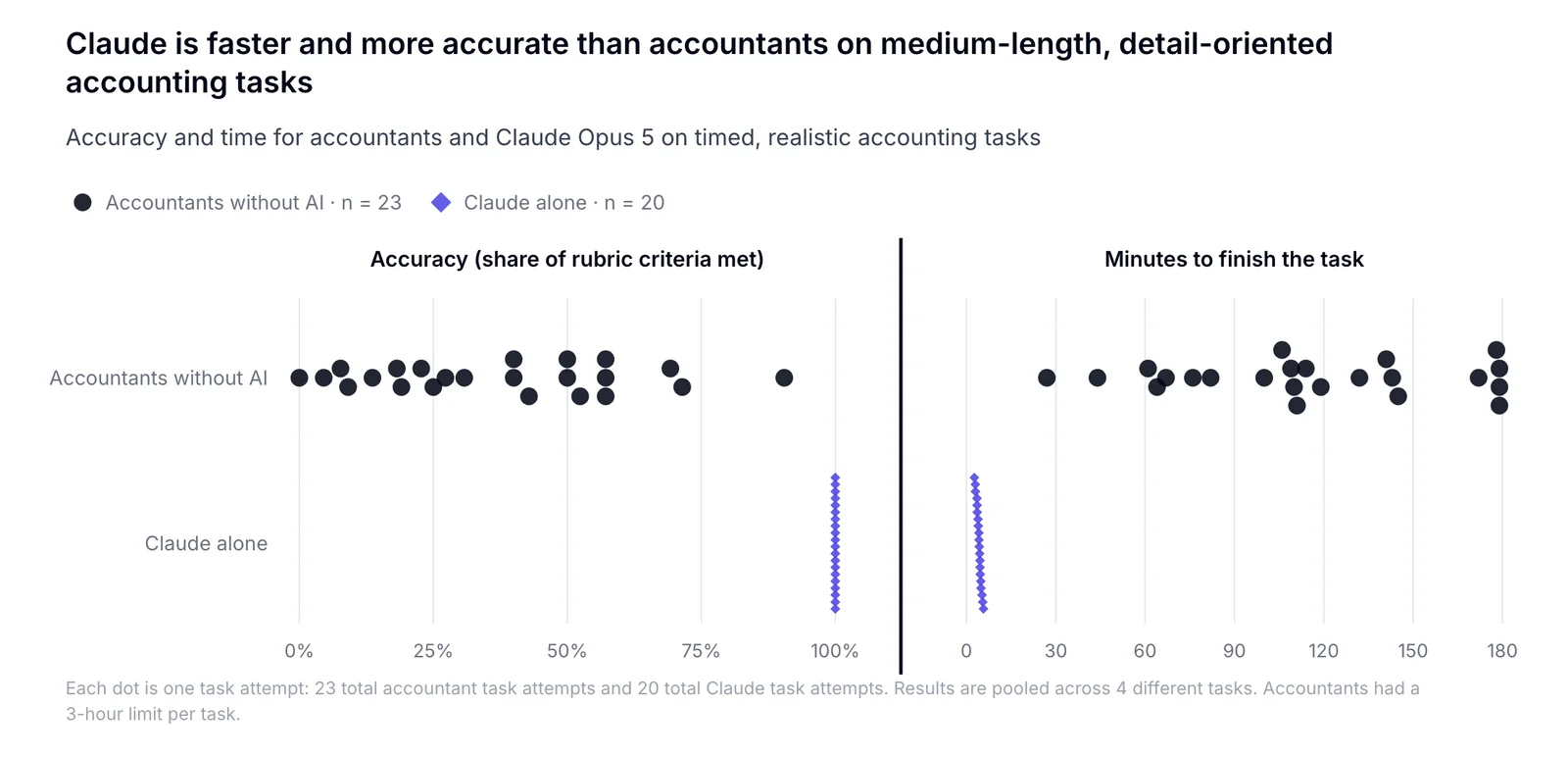
Mercor published a study on October 1, 2026, comparing 12 licensed CPAs with frontier AI models on four simplified month-end close tasks.
The participating CPAs averaged 5.4 years of experience. The human participants completed the work without AI assistance. On Mercor’s grading criteria, the accountants averaged approximately 37%.
Claude Opus 5 scored 100% on all 20 solo AI attempts, with each attempt completed in under 10 minutes.
Those numbers are real, but their scope is narrow:
- The test covered four simplified tasks, not the full month-end close process.
- The grading criteria emphasized detailed instruction following, locating information in files, calculations, and structured outputs.
- These are skills that current AI systems handle especially well.
- The human sample was small, and individual scores varied widely.
- Mercor itself said the test did not cover the full scope of an accountant’s job.
- Mercor is an AI talent marketplace with a business interest in demonstrating AI capability and the value of human evaluation and oversight.
The correct takeaway is not that AI has replaced accountants. The more useful question is: Which parts of a job are well-specified enough to automate, and what happens to the rest?
Quick Answer
AI beat the 12 CPAs on this specific paper exercise, not on accounting as a profession.
The benchmark is best understood as a spot check, not a performance review. It measured whether models and humans could complete four well-defined tasks using supplied files and explicit grading criteria. It did not measure relationship management, judgment under uncertainty, internal controls, regulatory accountability, or the ability to ask the right question when information is incomplete.
That still matters. Work that is repeatable, documented, and easy to grade is likely to face significant automation pressure. But the parts of a job that involve judgment, accountability, relationships, and responsibility may become more valuable, not less.
Why Trust This Article
This article separates the headline study from broader workforce evidence.
We reviewed Mercor’s original write-up, the full APEX-Accounting research paper, the Ramp Labs benchmark page, independent criticism from The Inference, coverage from The Decoder, and employment projections from the U.S. Bureau of Labor Statistics.
We also identify what the study did not test. That distinction is important because benchmark results can be accurate while still being easy to overinterpret.
AI Signal: One Benchmark, Three Different Jobs
What changed
Mercor reported that Claude Opus 5 outperformed 12 licensed CPAs on four simplified month-end close tasks.
The CPAs averaged approximately 37% on the study’s grading criteria. Claude Opus 5 scored 100% on all 20 solo attempts, finishing each in under 10 minutes.
The tasks required participants to work through company files, find relevant figures, perform calculations, and produce tables or schedules. The grading emphasized whether the final work followed instructions and satisfied specified criteria.
Why it matters
The finding shows how quickly AI capability can improve on structured knowledge work. A task that models struggled with 18 months earlier can become routine after several model generations.
For employers, this may reduce the time and cost required for certain close activities. For workers, it may change the career ladder. Junior employees who once built experience by preparing schedules, checking figures, and organizing workpapers may need to develop higher-value skills sooner.
But the headline comparison has clear limits.
This was not a test of whether AI could independently close a company’s books. It did not test the full set of decisions that accountants make when records conflict, documentation is missing, a policy is unclear, or a business leader needs an explanation rather than a completed spreadsheet.
The comparison also placed unassisted humans against AI. In a real workplace, the more meaningful comparison may be accountants using AI versus accountants working without it.
In real life
Think of an accounting department closing the books at the end of a quarter.
AI may be able to:
- Locate information across spreadsheets and documents
- Prepare a recurring reconciliation
- Calculate an accrual using a documented formula
- Draft a variance table
- Flag numbers that do not tie out
- Produce a first draft for review
The human team may still need to decide:
- Whether the available evidence is complete
- Which accounting policy applies
- Whether a transaction is unusual enough to investigate
- Whether an entry should be posted
- Who must approve the adjustment
- How to explain the result to executives, auditors, lenders, or regulators
That is why speed alone does not equal ownership. A fast answer can still create financial, tax, compliance, or reputational risk if no qualified person is responsible for the final decision.
Watch
The broader APEX-Accounting benchmark provides useful context. It includes 160 tasks across 10 simulated company environments, with reconciliations, data entry, variance analysis, schedules, and accruals.
On that broader benchmark, the leading model averaged 56.4% of expert-written criteria across a sample of runs. The best model solved at least one attempt on 21.5% of tasks, but no model solved more than 2.6% of tasks correctly on every one of eight attempts. The benchmark page also reports that 93 of 160 tasks were never fully solved by any model in any run.
That is a very different picture from 100% on 20 solo attempts. The difference is not necessarily a contradiction. It shows how much results depend on task selection, consistency standards, and whether the benchmark tests a narrow skill or a broader workflow.
Independent criticism also matters. The Inference argued that Mercor’s study used a small human sample, selected tasks that favored AI strengths, and came from a company with a commercial interest in human evaluation and human-in-the-loop services. That critique does not automatically invalidate the study. It does mean readers should examine the incentives and design before making career predictions.
The APEX paper itself acknowledges important limitations. It excludes tax, audit, consolidation, multi-entity and multi-currency work, external reporting, and tasks that require an agent to ask a human for clarification.
Source
Mercor: Human Baselines for Benchmarks
What the Benchmark Actually Measured
A useful way to analyze your own job is to sort your work into three buckets.
| Task bucket | Examples | AI exposure | What becomes valuable |
|---|---|---|---|
| 1. Well-specified and repeatable | Recurring reports, standard reconciliations, documented calculations, routine data entry | Highest | Workflow design, quality control, AI supervision |
| 2. Judgment and incomplete information | Investigating discrepancies, interpreting exceptions, choosing among reasonable options | Moderate | Critical thinking, business context, questioning assumptions |
| 3. Accountability, relationships, and regulatory responsibility | Sign-offs, client communication, policy ownership, audit responses, ethical decisions | Lowest | Trust, judgment, leadership, credentials, responsibility |
The first bucket is where automation usually starts because the work can be described, repeated, and graded.
The second bucket is harder. AI may generate useful drafts or identify patterns, but someone must determine whether the conclusion is reasonable.
The third bucket often carries the greatest premium. A company may automate preparation, but it still needs people who can explain decisions, accept responsibility, protect confidential information, and respond when the facts do not fit the template.
That framework applies well beyond accounting. A marketing analyst, paralegal, insurance adjuster, financial planner, or operations manager can ask the same three questions:
- Which tasks can be explained step by step?
- Which tasks require judgment when evidence is incomplete?
- Which tasks require someone to be trusted and accountable?
Editorial Perspective
The most important lesson is not that AI scored higher than 12 accountants. It is that the definition of “the job” is becoming more important than the job title.
A benchmark can show that a model is excellent at one part of accounting while being weak at another. The danger comes when the narrow result is used to make a broad claim about an entire profession.
For workers, the financial implication is practical. If most of your week is spent on bucket-one tasks, your exposure is higher. You should learn the tools that automate those tasks and move toward work involving review, interpretation, systems, controls, and communication.
For employers, the cost calculation should include supervision, error correction, security, implementation, and accountability. A model that completes a schedule in minutes may still require a qualified professional to validate the result.
The BLS provides separate context. It projects that employment of accountants and auditors will grow 5% from 2024 to 2034, with about 124,200 openings per year from growth and replacement needs. That projection does not prove that every accounting role is secure, and it does not measure the effect of this specific Mercor study. It does show why a narrow benchmark should not be treated as a complete forecast of employment.
What This Means for You
Whether you work in accounting or another white-collar field, take these steps:
1. Inventory your weekly tasks
List your recurring work and mark each task as:
- Repeatable and rules-based
- Judgment-heavy
- Relationship or accountability-heavy
Start with the repeatable work because it is most likely to be automated.
2. Learn to supervise outputs
You do not need to become an AI engineer. You do need to know how to check an output, identify unsupported assumptions, protect confidential information, and escalate uncertainty.
3. Build domain depth
The more you understand the business behind the numbers, the more useful you become when an AI system produces a technically polished but contextually wrong answer.
4. Strengthen communication
Explain financial information clearly to people who do not work in finance. Ask better questions. Document decisions. Those skills are harder to reduce to a file search and a grading rubric.
5. Protect your cash flow during career change
If your role is exposed to automation, do not wait for a layoff to prepare. Review your emergency savings, reduce high-cost debt, update your resume, and set aside a realistic budget for training.
ATMC’s coverage on what employers value beyond where you went to school is a useful companion to this discussion. For business owners, our guidance on managing positive cash flow can help connect workforce decisions to operating resilience.
ATMC Money Coach Box: AI may change how your income is earned before it changes your job title. Keep your financial foundation strong while you build skills that move you from routine execution toward judgment, communication, oversight, and trusted responsibility.
FAQ: AI Beat Accountants.
Will AI replace accountants?
AI is likely to automate more accounting tasks, especially work that is structured, repeatable, and easy to verify. The Mercor study does not prove that AI will replace accountants because it tested four simplified tasks rather than the full profession. Accountants who combine AI fluency with judgment, controls, communication, and business knowledge may become more valuable.
What were the 12 CPAs actually tested on?
They completed four simplified month-end close scenarios using company working files. The tasks required finding relevant information, doing calculations, and producing structured results. The grading emphasized detailed instruction following and other skills that current AI models handle well. It did not test the full end-to-end close process.
Is this study reliable?
It is credible evidence about performance on the four tasks tested. It is not sufficient evidence for broad conclusions about accountants or professional work. The study used only 12 CPAs, a small human sample, and it was published by Mercor, an AI talent marketplace with a commercial interest in AI capability and human evaluation. Independent critics have raised concerns about task selection, sample size, and incentives.
Will AI replace white-collar jobs?
AI is more likely to change the task mix inside many white-collar jobs before it eliminates entire occupations. Routine work faces more exposure. Work involving judgment, relationships, complex context, accountability, and regulation is harder to automate fully. The effects will vary by industry, employer, and worker.
How do I know if my job is at risk from AI?
Break your job into tasks rather than looking only at your title. Work is more exposed when it is repeatable, rules-based, digital, and easy to grade. Exposure is lower when the work requires incomplete information, negotiation, trust, physical presence, ethical judgment, or legal responsibility.
What skills should I build to stay valuable?
Build a combination of AI literacy and domain expertise. Learn to evaluate AI outputs, analyze data, communicate clearly, manage projects, spot exceptions, and make decisions when the evidence is incomplete. People who can connect technology to business outcomes will generally be better positioned than people who only perform routine steps.

Abdul Qadeer is a freelance writer and SEO assistant for AskTheMoneyCoach.com, the award-winning financial education platform founded by Lynnette Khalfani-Cox, also known as The Money Coach.
He collaborates closely with Lynnette and the editorial team to produce accurate, actionable content focused on personal finance, credit, and wealth-building strategies.
Abdul combines his SEO expertise with a passion for financial literacy to help readers make smarter money decisions and discover trusted financial resources.